Pound of Gold Worth: A Guide to Calculating Its True Value
Figuring out what a pound of gold is worth isn’t as simple as checking a single number. The final value really boils down to three key things: the live market price, the specific unit of weight being used, and the gold’s actual purity. Getting any of these wrong can lead to a valuation that is off by thousands of dollars.
So what’s the short answer? A standard (also known as Avoirdupois) pound of pure, 24k gold is worth a hefty sum, easily tens of thousands of dollars, but the exact figure changes with the daily market tides. Let’s dive into how you can calculate it with confidence.
What Determines the Value of a Pound of Gold

To get a real grip on the value locked inside a pound of gold, you have to look past the surface. Think of it like baking a cake; getting the final product right depends on using the correct ingredients in the right amounts. A small mistake in any one area can throw the whole calculation off.
Here are the three main drivers behind the price of gold:
- The Spot Price: This is the live, fluctuating market price for one troy ounce of pure gold. It’s the baseline that all gold values are built on, changing constantly based on global supply and demand.
- The Weight System: This is where many people get tripped up. Precious metals use a different “pound” (the Troy pound) than what you use at the grocery store (the Avoirdupois pound). Knowing the difference is absolutely critical.
- The Purity Level: Measured in karats or fineness, this tells you how much pure gold is actually in your item versus other metals like copper or silver that have been mixed in.
Putting a Price on a Pound
Let’s imagine you’re holding a standard pound of pure gold. That gleaming weight is equivalent to about 14.58 troy ounces, which is the standard unit for trading precious metals.
As of a hypothetical date, January 5, 2026, let’s say gold is trading at $4,427.07 per troy ounce. In that scenario, a single pound of pure gold would be worth roughly $64,539, based on spot prices from major markets like COMEX. You can track historical gold market trends on platforms like Trading Economics.
The calculation is pretty straightforward once you have the right numbers, and specialized tools make it easy to plug in the weight and purity for an instant melt value.
Estimated Value of One Avoirdupois Pound of Gold
The table below gives you a quick snapshot of how purity dramatically affects the value of a standard (Avoirdupois) pound of gold, using a hypothetical spot price for reference.
| Gold Purity | Pure Gold Content | Estimated Value (at $4,400/troy oz) |
|---|---|---|
| 24 Karat (99.9%) | 100% | ~$64,152 |
| 18 Karat (75.0%) | 75% | ~$48,114 |
| 14 Karat (58.3%) | 58.3% | ~$37,400 |
As you can see, dropping from pure 24k gold down to a common jewelry alloy like 14k reduces the value by over $26,000. Understanding these core elements is the essential first step. Each factor plays a vital role, and getting any of them wrong will lead to a significant miscalculation of what your pound of gold is really worth.
Why Not All Pounds Are Weighed the Same
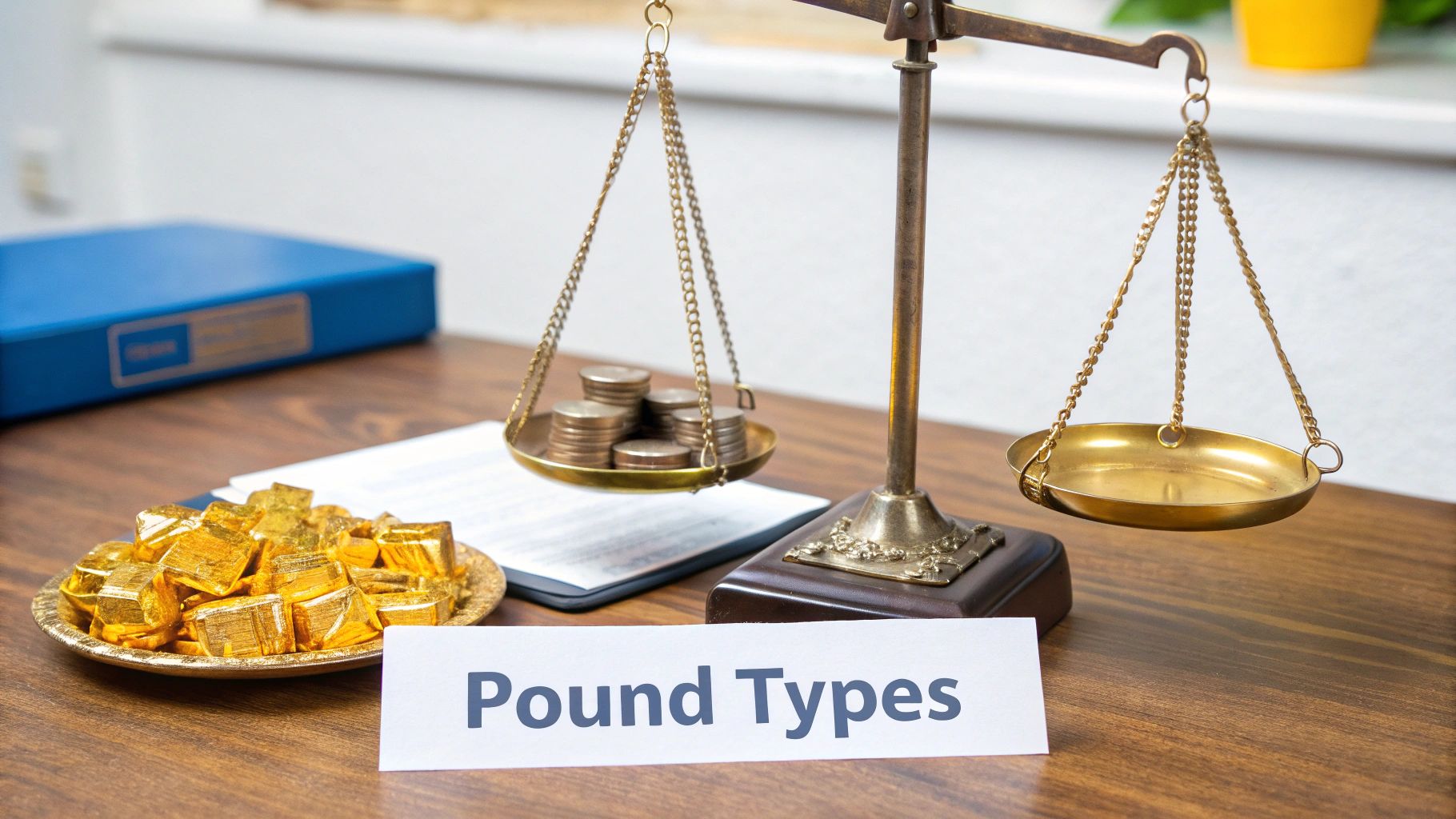
When you hear the word “pound,” your mind probably jumps straight to the everyday measurement for groceries, produce, or even your own body weight. This is the standard Avoirdupois pound, and it contains 16 ounces. Simple enough, right?
But here’s the catch: using that familiar unit to weigh precious metals is one of the most common, and costly, mistakes you can make.
The entire world of gold, silver, and platinum operates on a completely different system. Professionals use the Troy pound, which contains 12 troy ounces. This isn’t just a quirky detail; it’s the absolute foundation for valuing gold accurately.
The Critical Conversion You Must Know
So, what’s the big deal? It comes down to this: a troy ounce is actually heavier than a standard ounce. One troy ounce weighs in at about 31.1 grams, while a regular Avoirdupois ounce is only about 28.35 grams.
Because of this weight difference, the two types of pounds are not interchangeable. This dramatically changes any calculation of what a pound of gold is worth.
The most important conversion to remember is this: one standard Avoirdupois pound is equal to 14.583 troy ounces. It’s not 16, and it’s certainly not 12.
Get this conversion wrong, and your valuation will be wildly off. If you weighed your gold on a standard bathroom scale that read “one pound” and simply used the live price per ounce, you’d be overestimating its value by a huge margin. The global gold market only quotes prices in troy ounces, so every calculation has to start there.
You can dive deeper into the differences between a gold troy ounce vs a regular ounce to really get a handle on this crucial concept. This is exactly why you’ll never see a professional in the precious metals industry using a kitchen scale. They rely on scales calibrated specifically to troy ounces and grams to ensure total precision.
Comparing Avoirdupois and Troy Systems
Seeing the numbers side by side makes the difference impossible to ignore. A simple mix up between these two systems can throw off your valuation by more than 8%.
| Measurement System | Ounces Per Pound | Used For |
|---|---|---|
| Avoirdupois | 16 Ounces | Everyday goods (food, postage, people) |
| Troy | 12 Troy Ounces | Precious metals (gold, silver, platinum) |
Ultimately, just knowing that gold plays by its own rules is the first big step toward becoming a savvy seller or buyer. Always, always confirm which unit of measurement is being used in any transaction. By converting everything to troy ounces right from the start, you ensure your estimate for a pound of gold’s worth is built on the same foundation used by financial markets across the globe.
How Gold Purity Changes the Final Price
Once you’ve got the correct weight in troy ounces, the next critical step is figuring out your gold’s quality. The purity, measured in karats (K), has a massive impact on the final price. Pure gold is rarely used for jewelry and even some coins because it’s just too soft for daily life.
Think of it like a recipe. An item stamped 24k is the real deal, clocking in at 99.9% pure gold. But most pieces you’ll come across are alloys, meaning the gold has been mixed with other metals like copper, silver, or zinc to make it stronger and more durable.
This is why understanding karat levels is so important. A pound of 14k jewelry isn’t a pound of pure gold; it’s a pound of a metal alloy that’s only partially gold.
Breaking Down Karats and Fineness
Every karat rating corresponds to a specific percentage of pure gold. You might also see a “fineness” scale used, which is just another way of saying the same thing. For example, a 24k gold bar has a fineness of 999, while an 18k ring has a fineness of 750.
A common mistake is assuming that one pound of 14k gold has the same value as one pound of 24k gold. In reality, the 14k pound contains 41.7% less pure gold, which drastically reduces its melt value.
To figure out how much pure gold you actually have, you simply multiply the item’s total weight by its purity percentage. This extra step is non negotiable if you want an accurate valuation. You can learn more about the specifics of testing for gold purity to verify these ratings yourself.
Gold Karat to Purity Conversion Guide
Here’s a handy table that breaks down the most common karat ratings, showing you exactly how much pure gold is in your items.
| Karat (K) | Fineness | Pure Gold Percentage |
|---|---|---|
| 24K | 999 | 99.9% |
| 22K | 916 | 91.6% |
| 18K | 750 | 75.0% |
| 14K | 583 | 58.3% |
| 10K | 417 | 41.7% |
| 9K | 375 | 37.5% |
As you can see, the differences are significant. Jewelers and collectors know that a hallmark like ‘375’ (which means 9k gold) slashes the potential melt value by 62.5% compared to pure gold, which is why precise testing matters so much. By identifying the correct purity, you move one step closer to knowing the true worth of your gold.
Calculating Your Gold’s Melt Value Step by Step
Now that we’ve covered the crucial details of weight and purity, let’s put it all together. This is where the magic happens, turning abstract concepts into a real dollar value for your gold.
Imagine you have a one pound bag filled with old 14k scrap jewelry. To a pawn shop or refiner, its value isn’t sentimental; it’s based purely on the amount of gold it contains. The calculation to find this “melt value” is surprisingly simple once you break it down.
The Four Steps to an Accurate Valuation
Getting to a final number just takes a few key moves. Each step builds on the last, taking you from a raw weight to a precise value based on the live market. Think of it as the recipe professionals use every day.
Here’s how it’s done:
- Get the Weight in Grams: First things first, you need an accurate weight. Using a digital gram scale, let’s say your one pound bag of jewelry weighs exactly 453.59 grams.
- Convert to Troy Ounces: The spot price of gold is always quoted in troy ounces, so we need to speak the same language. Divide your gram weight by 31.103 (the number of grams in one troy ounce). In our case: 453.59 grams ÷ 31.103 = 14.58 troy ounces.
- Find the Pure Gold Content: Your jewelry is 14k, which we know is 58.3% pure gold. To find out how much actual gold you have, multiply the total troy ounces by this percentage: 14.58 troy ounces x 0.583 = 8.5 troy ounces of pure gold. This is the number that really matters.
- Calculate the Final Value: Check the current spot price of gold. Let’s assume the price is $2,350 per troy ounce. Now, multiply that price by your pure gold content: $2,350 x 8.5 = $19,975.
Just like that, our one pound bag of mismatched 14k scrap jewelry has a melt value of nearly $20,000. Not bad for something that might have been collecting dust.
This entire sequence, weighing in grams, converting to troy ounces, adjusting for purity, and multiplying by the spot price, is the exact formula professionals use. It cuts through the noise and anchors your estimate in real world data.
Want to Skip the Math?
Doing the calculation yourself is empowering, but let’s be honest, it can also be a bit of a hassle. That’s where modern tools make life easier. An online calculator automates the whole process, giving you a precise answer in seconds.
The infographic below shows why that purity calculation (step 3) is so critical. It visualizes the journey from a pure gold bar to the alloyed jewelry we actually wear.
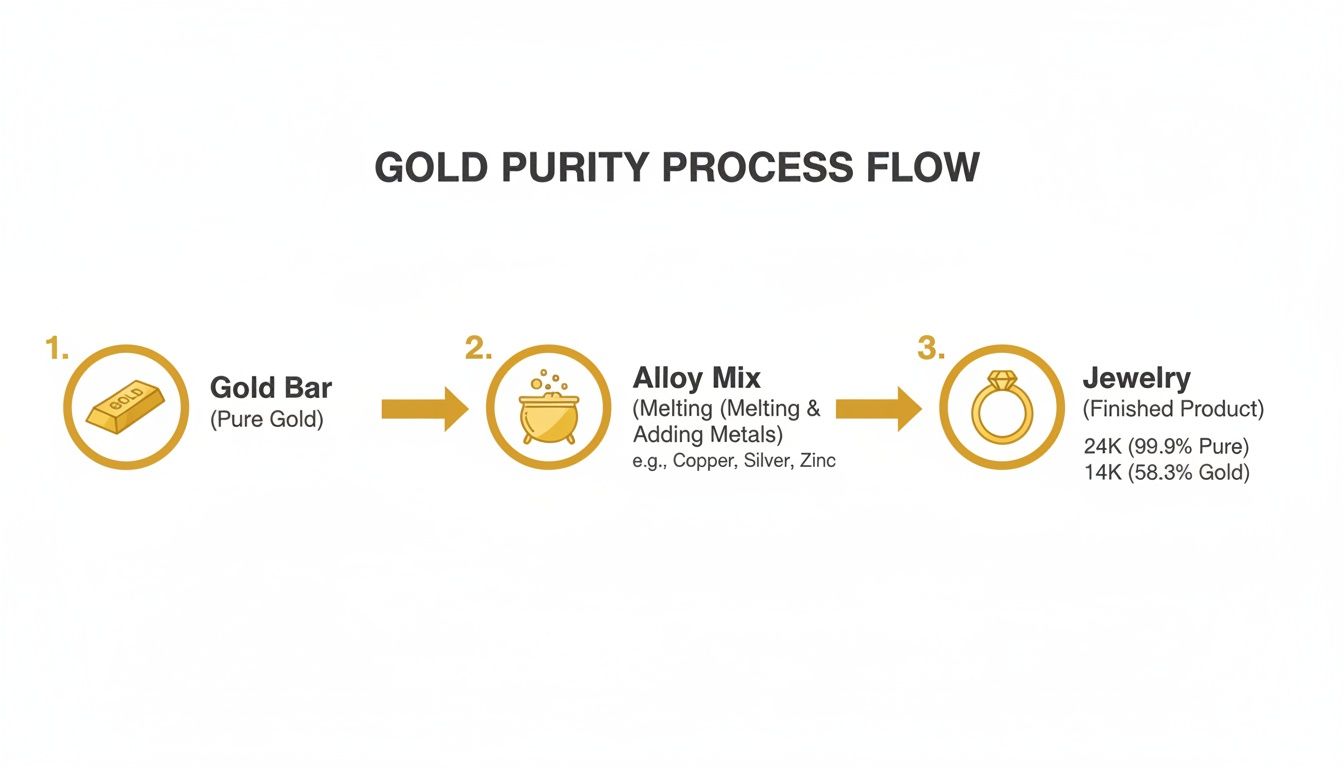
This process is exactly why we have to account for purity, most jewelry is a mix of gold and other metals, not pure 24k.
By using an automated tool, you can skip the manual conversions and get straight to the bottom line. For an instant, accurate valuation based on live market data, you can find out the current price with a real-time gold price calculator today. It ensures your numbers are always current, giving you the confidence you need to make your next move.
The Difference Between Market Value and Cash Offers
So you’ve run the numbers and calculated the melt value of your gold. It’s easy to get excited by that final figure, but hold on, there’s one crucial last step. The number on your calculator isn’t the same as the cash offer a buyer will hand you.
This gap between the theoretical market price and a real world payout is a normal, expected part of selling gold.
Think of it like selling a used car. The original sticker price is one thing, but the trade in offer you get from a dealership is always going to be lower. Gold buyers operate on a similar principle, factoring in their own business costs and the need for a profit margin before they can make you an offer.
Why Your Payout Is a Percentage of the Spot Price
When you sell gold, especially scrap jewelry or other non bullion items, the buyer has to do some work to turn it back into pure, marketable gold. Those steps cost money, and those expenses are what shape the final payout they can offer you.
A reputable buyer will typically offer you a payout percentage, a portion of the total melt value. This isn’t just arbitrary; it’s a number that accounts for the real costs of their operation.
The cash offer you receive is simply the gold’s melt value minus the buyer’s operational costs and profit margin. That’s why offers are presented as a percentage, ensuring the transaction works for their business while still being fair to you.
Common Deductions That Affect Your Offer
So, what exactly are these costs? They’re the necessary expenses involved in recycling your gold and getting it ready to re enter the market. A buyer’s offer will almost always account for the following:
- Refining and Smelting Costs: The process of melting down jewelry, removing impurities like other metals, and creating pure 24k gold isn’t free.
- Assay Fees: Buyers have to pay for professional testing (assaying) to verify the exact purity of the gold they’re buying.
- Business Overhead: This covers everything from rent and employee salaries to security and insurance.
- Profit Margin: Just like any other business, a gold buyer needs to make a profit to stay in operation.
For sellers with scrap jewelry, this means buyers typically pay between 70% to 95% of the melt value after factoring in these costs. To put that in perspective, a pound of 14 karat necklaces could fetch anywhere from $22,000 to $36,000 in cash.
That’s a huge range, and it’s why using a real time calculator is so important. Recent surges in gold’s market performance on Trading Economics have turned what used to be modest scrap piles into some serious money. Understanding the payout process helps you manage your expectations and know a fair deal when you see one.
Why Has Gold Always Been So Valuable? A Quick History Lesson
To get a real feel for why a pound of gold is worth so much, you have to look past today’s price charts and take a trip back in time. Gold’s reputation wasn’t built in a day. It was forged over centuries of economic booms, busts, and complete overhauls of the global financial system. Its real magic lies in its uncanny ability to hold its ground when other assets crumble.
Think about it this way: before 1971, the world was on what’s called the gold standard. This meant the U.S. dollar was directly exchangeable for a fixed amount of gold, which kept the currency’s value tied to a real, physical asset. When President Nixon severed that tie, gold was set free to trade on the open market. What happened next was a masterclass in why gold has intrinsic value, completely separate from any government’s say so.
Gold’s Price at Key Moments in History
The story of gold’s price is really a story of our own economic history. The numbers are staggering when you see them laid out.
Back in 1497 Spain, during the Edict of Medina, an ounce of gold was worth just $10.07, making a pound of gold a mere $147. Fast forward to 1800, and the price had inched up to $15.30 per ounce, or $223 a pound.
But the real fireworks started after the 1971 “Nixon Shock” cut the dollar’s tie to gold. The price exploded from a government fixed $35 an ounce ($510 per pound) and rocketed to an unbelievable $850 an ounce ($12,393 per pound) by January 1980. If you want to dive deeper into these numbers, SD Bullion has a great overview of gold’s historical price journey.
To really grasp its power against inflation, just look at what a pound of gold could buy then versus now.
| Era | Price per Avoirdupois Pound | What It Could Buy (Approximately) |
|---|---|---|
| 1970 | ~$510 | A brand new economy car |
| Today | ~$60,000+ | A luxury SUV or a significant down payment on a house |
This isn’t just about keeping up with inflation; it’s about dramatically outperforming it. While the dollars in our pockets buy less and less each year, gold has consistently grown in real world purchasing power, cementing its place as the ultimate financial safeguard.
Common Questions About Gold Value
After breaking down the core concepts of weight, purity, and market price, a few more questions usually come up. Getting these last details ironed out will give you a rock solid understanding and help you walk into any gold transaction feeling confident.
How Much Is a Troy Pound of Gold Worth?
This is a great question because it often trips people up. A troy pound is not the same as the standard pound we use for groceries. A troy pound contains exactly 12 troy ounces.
To figure out its value, you just multiply the current spot price of gold per troy ounce by 12. So, if gold is trading at $2,350 per troy ounce, a troy pound of pure 24k gold is worth $28,200. This is a completely different calculation, and a much different result, than you’d get using a standard Avoirdupois pound.
What Is the Best Way to Weigh Gold at Home?
For the most reliable results at home, a digital gram scale is your best friend. A small jeweler’s or postage scale will be far more precise than your kitchen scale and give you an accurate starting point.
Always weigh your items in grams. It’s the standard unit used by professionals and can be easily converted to troy ounces (1 troy ounce = 31.103 grams), which is how the spot price is quoted.
The melt value is based purely on weight and purity, so a pound of 14k gold has the same intrinsic value whether it’s in the form of jewelry, coins, or a bar.
That said, the final resale value can be a different story. Bullion bars and coins typically sell very close to their spot price value. Scrap jewelry, on the other hand, is valued almost exclusively on its raw gold content.
And then there are special cases. Rare coins or high end designer jewelry can have a collectible value that blows their melt price out of the water. If you want to dive deeper, you can explore gold’s price history and performance on BullionByPost to see just how remarkable its long term performance has been.
Ready to skip the manual math and get an instant, accurate value for your gold? The Gold Calculator uses live market data to give you a precise estimate in seconds. Try our free Gold Calculator today and see what your gold is really worth.