How Much Is Scrap Gold Worth: A 2026 Guide to Valuation
Have you ever looked at that old gold jewelry tucked away in a drawer and wondered what it is really worth? The answer might surprise you.
The value isn’t based on what you paid for it, but on the pure gold it contains multiplied by the current market price. Let’s make this real. A simple 10 gram 14K gold chain, which is 58.3% pure gold, could easily be worth over $800 based on its melt value alone, depending on the day’s gold prices.
This guide will walk you through exactly how that value is determined, so you can sell with confidence.
What Really Determines Your Scrap Gold’s Value
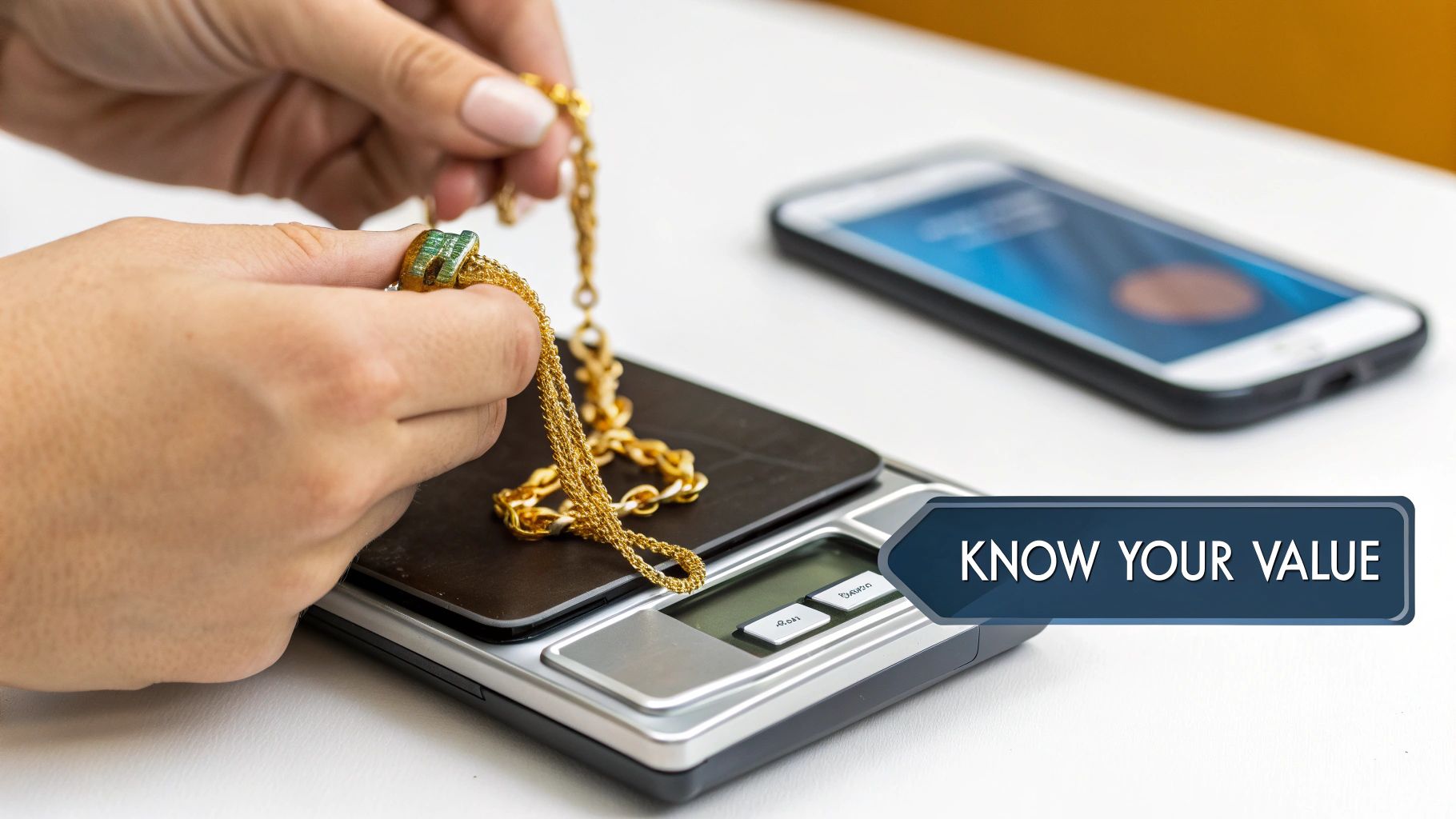
Ever wondered how a broken necklace or a single earring turns into cash? The concept is surprisingly straightforward. The price is based on its melt value, a number figured out using three key factors. Once you understand this simple formula, you will know what your scrap gold is truly worth.
Think of it like pricing a high quality chocolate bar. The final price depends on the cocoa percentage, its total weight, and what cocoa beans are selling for on the market that day. Scrap gold is no different. Every buyer uses this simple approach to make you an offer. Understanding it cuts through the confusion and gives you the power to confidently judge any payout you are offered.
The Three Pillars of Gold Valuation
The value of your scrap gold is not a random number a buyer pulls out of thin air. It is a calculation based on a clear, consistent set of criteria that everyone in the industry uses.
Here are the three non negotiable elements that go into every valuation:
- The Live Spot Price of Gold: This is the real time market price for one troy ounce of pure, 24 karat gold. It shifts constantly throughout the day based on global trading.
- Gold Purity (Karats): That little stamp on your jewelry, like 10K, 14K, or 18K, tells you what percentage of the item is pure gold. Since most jewelry is mixed with other metals to make it stronger (called an alloy), this is a critical piece of the puzzle.
- Accurate Weight: The total weight of your item, usually measured in grams, determines how much of that pure gold you actually have.
What is melt value? Melt value is the raw, intrinsic worth of the precious metal in your item. It strips away any value from the design, brand, or sentiment. When it comes to scrap gold, this is the number that truly matters.
This table breaks down how these three pillars work together to set your item’s base value, before a buyer takes their percentage.
| Factor | What It Represents | Why It Matters for Your Payout |
|---|---|---|
| Spot Price | The current market rate for pure gold. | Establishes the baseline value per ounce or gram. |
| Purity (Karat) | The percentage of pure gold in the alloy. | Determines how much of your item’s weight is actual gold. |
| Weight | The total mass of your gold item. | The more it weighs, the more pure gold it contains. |
By combining these three factors, any gold buyer can calculate the total melt value for any piece of gold. This figure is your starting point for any negotiation. For a deeper dive into these principles, check out a comprehensive guide to your gold’s true value.
And if you want to see these factors in action right now, you can check the latest scrap gold price using real time data.
The Four Factors That Dictate Your Payout
So, what actually determines how much cash you’ll get for your scrap gold? It is not just a number pulled out of thin air. Professional gold buyers use a clear, four part formula to arrive at their offers. Understanding these factors is the key to knowing your gold’s true worth and making sure you get a fair deal.
Think of it as the four pillars of gold valuation. Each one plays a critical role, and together they build the final number you see on the check. Let’s break them down in a conversational way.
Gold Purity and Weight
First up is the Live Spot Price of gold. This is the big one, the baseline for everything. It is the real time price for pure, 24 karat gold on the global market, set by major exchanges like COMEX. Just like a stock price, it bounces up and down all day based on economic news, currency strength, and investor sentiment. Every calculation starts here.
Next, we have Gold Purity, which you’ll recognize as the karat (K) stamp on your jewelry. Pure gold is beautiful but way too soft for most accessories, so it is mixed with stronger metals to create a durable alloy. The karat marking tells you exactly how much of that alloy is pure gold.
For example, a 10K piece is 41.7% pure gold, and a 14K item jumps up to 58.3% pure gold. An 18K piece is even richer at 75% pure gold. It is simple: the higher the karat, the more gold is packed into every gram, making it more valuable.
The third pillar is Weight. Any reputable buyer will use a precise, calibrated scale to weigh your items, usually in grams or pennyweights (dwt). For reference, one pennyweight equals about 1.555 grams. You do not need to do the conversions yourself, but just know that an accurate weight is absolutely non negotiable for an honest valuation.
Buyer Margins and Realistic Payouts
Finally, we get to the part that many sellers miss: the Buyer’s Margin. This is what separates the raw value of your gold from the actual cash you will receive. No buyer can pay you 100% of the spot price value. Their offer has to account for their own business costs, things like refining, smelting, overhead, and of course, their profit.
A realistic cash payout for scrap gold typically ranges from 70% to 95% of its calculated melt value. Reputable buyers generally fall within the higher end of this range, often between 80% and 90%.
That margin is why a piece with a calculated melt value of $500 might fetch you an offer of around $425. That difference is not a ripoff; it is the cost of turning your unwanted jewelry back into pure, refined gold that can be used again.
Recent surges in the price of gold have made these payouts more significant than ever. For instance, strong gold prices have directly inflated scrap gold’s melt value across the board, boosting recycling efforts by 6% globally. For a seller, this means a 100 gram 22 karat necklace could have a melt value well over $10,000, though any realistic cash offer will still reflect that buyer’s margin. You can learn more about how gold demand trends impact scrap prices directly from the experts.
Here’s a quick reference table to help you see the pure gold content in the most common jewelry alloys you will find.
| Karat Marking | Fineness Stamp | Pure Gold Percentage | Common Use Case |
|---|---|---|---|
| 10K | 417 | 41.7% | Durable everyday jewelry like rings and chains. |
| 14K | 585 | 58.3% | The most popular choice for fine jewelry in the US. |
| 18K | 750 | 75.0% | A higher end option common in luxury and European jewelry. |
| 22K | 916 | 91.7% | Very soft, often used for investment grade coins and cultural jewelry. |
| 24K | 999 | 99.9% | Pure gold, typically found in bullion bars and coins. |
Calculating Your Scrap Gold’s Worth Step by Step
Alright, we have covered the key factors that go into a gold quote. Now, let’s put that theory into practice. Seeing the numbers in action is the best way to get a real feel for how much your scrap gold is worth.
This section will walk you through the math, step by step. We will take these abstract concepts and turn them into concrete dollars and cents.
I will run through two common scenarios to show you just how simple the calculation can be. Once you see how it works, you’ll be able to estimate your own gold’s value with confidence.
Example 1: The 14K Gold Chain
Let’s start with a classic piece, a 15 gram 14K gold chain. For this example, we’ll say the live spot price of gold is $75 per gram.
Here’s how the math breaks down:
- Find the Pure Gold Content: First, we need to know how much actual gold is in the chain. A 14K piece is 58.3% pure gold. To figure out the pure gold weight, we just multiply the total weight by this percentage.
- Calculation: 15 grams x 0.583 = 8.745 grams of pure gold.
- Calculate the Melt Value: Now that we have the pure gold weight, we multiply it by the current spot price per gram.
- Calculation: 8.745 grams x $75/gram = $655.88.
This $655.88 is the chain’s total melt value. Think of this as the 100% market value of the raw gold in your item. A buyer’s offer will be a percentage of this. For instance, if a buyer offers 85% of the melt value, your payout would be around $557.50.
The process is always the same: start with the market price, then adjust for the purity and weight of your specific item.
This visual really nails it down. Spot price, purity, and weight are the three building blocks for determining any gold item’s base value.
Example 2: The 18K Gold Ring
Next up, let’s value something you would get from a jeweler: a 5 dwt 18K gold ring. Jewelers often use pennyweights (dwt), so it is good to know how to handle them.
Since spot prices are almost always listed per gram or troy ounce, our first step is a simple conversion. One pennyweight is equal to 1.555 grams.
Let’s follow the same steps:
- Weight Conversion: 5 dwt x 1.555 = 7.775 grams.
- Pure Gold Content (18K is 75% pure): 7.775 grams x 0.750 = 5.831 grams of pure gold.
- Melt Value (at $75/gram): 5.831 grams x $75/gram = $437.33.
The key takeaway here is that no matter the unit of measurement or the karat, the formula does not change. Just convert to a standard weight (grams), find the pure gold content, and multiply by the live spot price.
If you have old jewelry tucked away, its scrap value is tied directly to these live market prices. A 10 gram 14 karat ring, for example, could have a melt value of $600 to $700 depending on the day’s spot price. Remember, a buyer’s actual offer will typically fall in the 70% to 95% range of that number.
To get a better sense of how global supply and demand affect these values, you can find great insights in the gold supply reports on ScrapMonster.com. Running these simple calculations yourself is the best way to know what your items are really worth before you walk in the door to sell.
Understanding Gold Purity Marks and Percentages
That tiny stamp on your gold jewelry? It is the single most important clue to its value. Known as a hallmark or purity mark, this little inscription tells you exactly what percentage of your item is pure gold. Getting a handle on these numbers is the very first step in figuring out what your scrap gold is really worth.
Pure gold, which is 24 karat (24K), is actually incredibly soft, way too soft for a ring or necklace you would wear every day. To make it durable enough to last, it is mixed with stronger metals like copper, silver, or zinc. This blend is called an alloy, and the karat number simply tells you the ratio of pure gold to those other metals.
Decoding Karats and Fineness
You will generally run into two types of purity marks. Here in North America, we are most familiar with the karat system (you will see stamps like 10K, 14K, or 18K). But in Europe and other parts of the world, a three digit “fineness” number is the standard. This number just represents the gold content in parts per thousand.
For example, a stamp reading “585” means the item is 585 parts pure gold out of 1,000. That works out to 58.5% pure gold, which is the same as 14K gold. Knowing both systems means you can confidently identify gold from pretty much anywhere. If you find a mark that is hard to identify, our detailed guide on gold purity testing can help you figure it out.
To make it even easier, here’s a quick breakdown of the most common purities you’re likely to find in your jewelry box.
Gold Karat Purity Comparison
This table shows the pure gold content for common karat levels, helping you identify the value of your jewelry.
| Karat (K) | Fineness (Hallmark) | Pure Gold Percentage (%) | Common Uses and Characteristics |
|---|---|---|---|
| 10K | 417 | 41.7% | Highly durable and affordable, great for everyday rings. |
| 14K | 585 | 58.3% | The most popular choice in the U.S. for a balance of color and strength. |
| 18K | 750 | 75.0% | A rich, yellow hue common in high end and European jewelry. |
| 22K | 916 | 91.7% | Very soft with a deep golden color, often used for investment pieces. |
| 24K | 999 | 99.9% | Pure gold, typically found in investment bullion bars and coins. |
As you can see, it is a simple relationship: the higher the karat number, the more pure gold your item contains.
The higher the karat number, the more pure gold your item contains, and therefore, the higher its melt value will be. An 18K ring will always be worth more than a 10K ring of the exact same weight.
This direct link between purity and value is precisely why finding that hallmark is so crucial. It’s the foundation for any accurate price calculation, and it is what allows you to move on to the next steps: weighing your item and figuring out its value based on the live gold market.
Using a Gold Calculator for Instant Estimates
While running the numbers yourself is a great way to understand how your gold is valued, technology offers a much faster and more accurate shortcut. An online gold calculator is the perfect tool for getting an instant, transparent estimate of what your scrap gold is worth, completely eliminating the guesswork and potential for human error.
These tools do all the heavy lifting for you. They automatically pull live spot prices from verified market sources, so your estimate is always based on the most current data available. This means you do not have to worry about tracking the constantly fluctuating prices yourself.
How to Get Your Instant Estimate
Using a tool like our free scrap gold calculator is incredibly easy. All you need are three simple pieces of information about your items.
- Select the Karat: Just choose the purity of your gold from the dropdown menu (e.g., 10K, 14K, 18K).
- Enter the Weight: Type in the weight of your item from your digital scale.
- Choose the Unit: Select the unit of measurement you used, whether it is grams, pennyweights (dwt), or ounces.
That’s it. The calculator instantly crunches the numbers, giving you a precise melt value based on real time market prices.
The biggest advantage of using a gold calculator is getting a reliable baseline value. When you walk in armed with this number, you can confidently evaluate any offer a buyer makes and know right away if you are being undervalued.
The process is designed to be simple and clear, letting you get an immediate value without any confusion.
Factoring In Realistic Payouts
The best calculators do not just stop at the raw melt value; they also help you see what a realistic offer might look like. Since buyers typically pay between 70% to 95% of the melt value, good tools will let you slide a payout percentage to see how that affects your bottom line.
This feature is what transforms a raw number into a practical estimate of the actual cash you can expect to walk away with.
For everyday sellers, this function is crucial. For instance, a pile of 18K scrap might have a total melt value of $2,200, but after refining fees and the buyer’s margin, most offers will probably land closer to 80% or 90% of that figure. A calculator that lets you see that range ahead of time puts you in a much stronger negotiating position.
How to Get the Best Payout for Your Scrap Gold
When it comes to selling scrap gold, knowledge is not just power, it is money in your pocket. Securing the best possible price boils down to one thing: knowing what your gold is worth before you ever walk through a door or click “sell” online.
Always keep in mind that every single offer you get is based on four key factors: the live spot price of gold, the purity (karat) of your items, their exact weight, and the buyer’s own fees and profit margin.
Before you even think about talking to a buyer, your first move should be to establish a solid baseline. Hop on a free tool like TheGoldCalculator.com to get a data backed estimate of your gold’s melt value. This simple step takes all the guesswork out of the equation and arms you with the most important number in the negotiation.
Your goal is to find a transparent buyer who offers a fair percentage of your gold’s melt value. Never, ever settle for the first quote you receive.
To make sure you are getting what your gold is actually worth, just follow these simple but incredibly effective steps.
| Step | Action | Why It Matters |
|---|---|---|
| 1. Calculate First | Use a free online calculator to find your gold’s melt value. | This gives you a hard, non negotiable baseline price. |
| 2. Shop Around | Get quotes from multiple sources, local jewelers, pawn shops, and reputable online buyers. | This quickly reveals who is offering the most competitive payout. |
| 3. Ask Questions | Ask potential buyers how they arrived at their offer. Are there any hidden fees for refining or processing? | This pushes for transparency and helps you spot a fair deal. |
| 4. Be Ready to Walk | Do not be afraid to decline lowball offers or walk away from high pressure tactics. | This puts you in complete control of the sale. |
For those looking to really maximize their return, timing can be everything. Taking a moment for understanding current gold price trends and optimal selling times can make a significant difference.
Once you’ve done your homework, the final step is simple: act with confidence. You know what you have, and you know what it’s worth.
Frequently Asked Questions About Selling Scrap Gold
Even after you have done your homework, a few last questions usually pop up. Getting clear, honest answers is the final step to feeling great about your sale. Let’s tackle some of the most common things people ask right before they sell.
What Percentage of the Spot Price Should I Expect?
Realistically, you should expect an offer between 70% and 95% of your gold’s actual melt value. Most reputable, transparent buyers will fall in the higher end of that spectrum, usually from 80% to 90%.
That margin is not just pure profit for them; it covers their refining fees, operational costs, and business overhead. If you get an offer that dips below 70%, it is a lowball. You should thank them for their time and immediately look for other quotes. This is exactly why you calculate the melt value on your own first, it is your baseline, the number that empowers you to spot a fair deal in an instant.
How Can I Test My Gold’s Purity at Home?
While nothing beats a professional appraisal, you can do a few simple checks at home to get a better idea of what you have. First, grab a magnifying glass and look for a hallmark, that tiny stamp like 14K or 585 that indicates its purity.
Next, try the magnet test. Gold is not magnetic. If your item snaps right onto a strong magnet, it is almost certainly not solid gold, or it has very little gold content. For a more definitive (but slightly risky) check, you could buy an acid test kit online, but be warned: it involves scratching your item and can cause damage. For anything you suspect is high value, a non destructive professional test is always the safest bet.
Does the Condition of My Scrap Gold Affect Its Price?
For true scrap gold, the condition is almost completely irrelevant. A buyer is interested in one thing and one thing only: its melt value, which is determined purely by the weight and purity of the gold inside.
This means a mangled chain, a dented ring, or a single earring is worth the exact same as a pristine item with the identical weight and karat. The design, brand, and condition simply do not enter the equation. The only time this is not true is if you have a rare antique or a piece from a sought after designer. In that case, it could be worth far more than its scrap value and should be appraised by a specialist, not sold to a scrap buyer.
Ready to find out the true, data driven value of your gold? At Gold Calculator, we give you the tools you need for a transparent and fair valuation. Use our free, real time calculator at https://thegoldcalculator.com to get an instant estimate and sell with total confidence.