What Is My Gold Worth A Guide To Its True Value
Wondering, “what is my gold worth?” It all boils down to three core ingredients: how much gold you have (weight), how pure it is (karat), and the current market price (spot price). Think of it like a recipe. When you understand these three elements, you will know its true value.
Understanding Your Gold’s Real Value
Figuring out what your gold is actually worth does not have to feel like cracking a secret code. It is a simple formula, and you definitely do not need to be a professional appraiser to get a solid estimate. The goal here is to get you thinking like the pros, focusing on the same factors they use to put a price on any piece of gold.
This guide will walk you through that process step by step, making the whole thing feel much more approachable. It is a similar mindset to valuing your collection of valuable items, where knowing what to look for can reveal some serious hidden value.
The Key Factors at a Glance
Before we dive into the math, let’s quickly break down the essential components that drive your gold’s price. Each one plays a crucial role in the final number.
- Purity (Karat): This is a simple way of saying how much actual gold is in your item. A 24K piece is pure gold, while a 14K piece is 14 parts gold mixed with 10 parts of other, stronger metals.
- Weight (Grams): This is straightforward. The heavier the item, the more gold it contains. A good digital scale is your best friend for this part.
- Spot Price: This is the live, fluctuating market price for one troy ounce of pure gold. It changes constantly throughout the day based on global trading.
Right now, the gold market is very active. Prices have climbed to high levels, driven by strong demand from large banks and investors. For anyone looking to sell gold jewelry, that is fantastic news. Those high spot prices mean your items are worth more.
Just keep in mind, the final offer you get will likely be 70% to 95% of the melt value. Buyers have to account for their own costs, like refining fees and their profit margin, which is a standard part of the business.
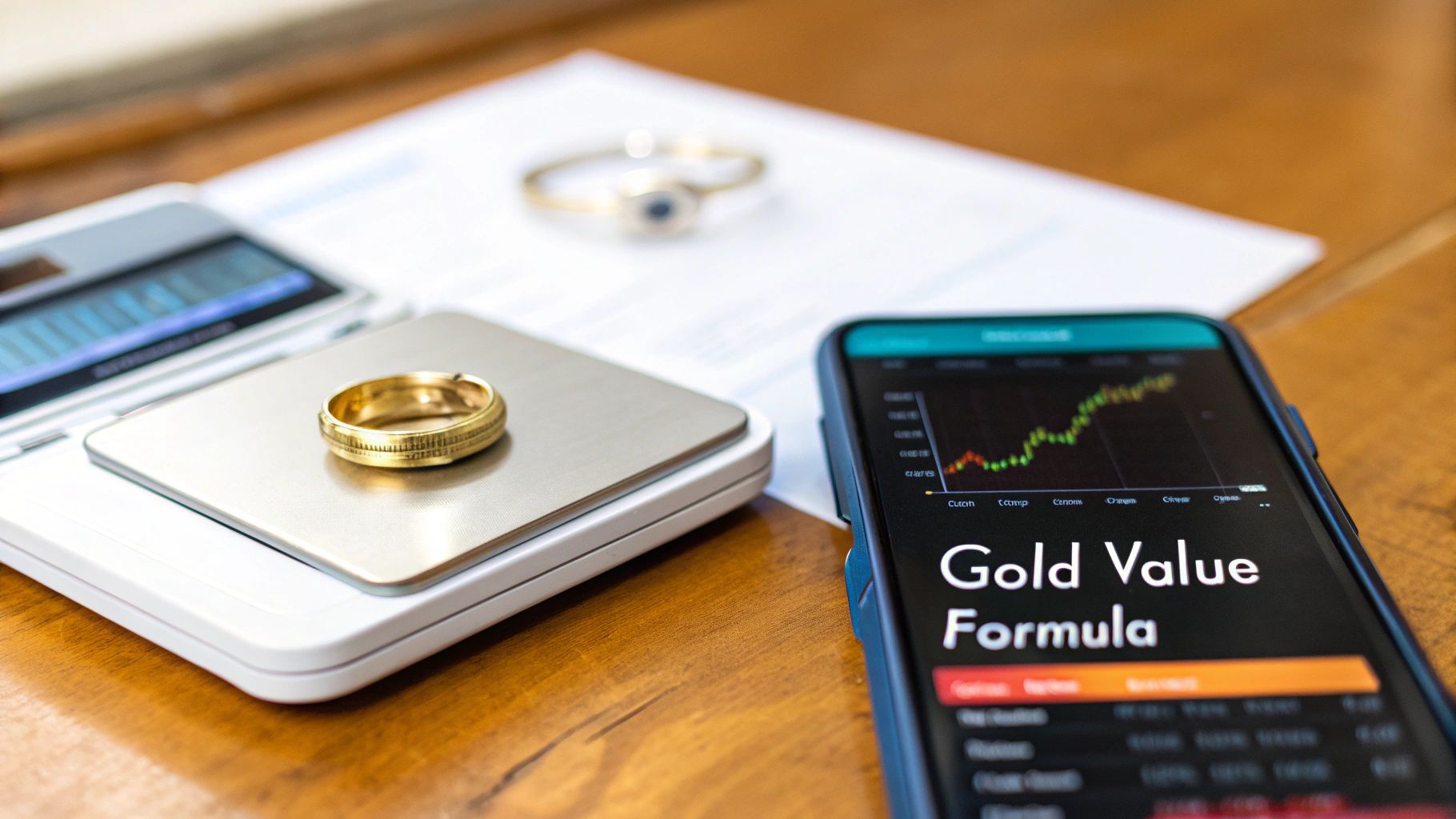
As you can see, tools like this make the process easy. You just plug in the weight and karat, and it does the hard work for you, giving you an instant estimate based on live market data. You can even factor in potential refining fees to get an even clearer picture of what your gold is worth today.
The Three Pillars of Gold Value: Purity, Weight, and Spot Price
So, what is your gold really worth? To get an accurate answer, you need to understand the three core elements that determine its value. Think of them as the legs of a stool. Without all three, you cannot get a stable or accurate price.
These pillars are the live market rate, the purity of your gold, and its precise weight.
Grasping how these three factors work together is the single most important step in figuring out the true melt value of your items. It moves you from guessing to knowing, giving you the confidence to evaluate any offer you receive. Let’s break down each pillar so you can see how they directly influence that final number.
Pillar One: The Live Gold Spot Price
First up is the spot price of gold. This is the live, up to the minute market price for one troy ounce of pure, 24 karat gold. It is the universal benchmark that buyers, sellers, and investors use worldwide.
Think of it like the stock market. The price of gold is not static; it fluctuates constantly throughout the day based on supply, demand, economic news, and global trading. This is why you might get a slightly different quote in the morning than you would in the afternoon. Any reliable valuation has to start with the most current spot price available.
The global appetite for gold has a huge impact on this price. For example, investor and retail demand for gold has accelerated dramatically, with global gold ETFs recording unprecedented inflows. By the third quarter of 2025, combined investor and central bank gold demand reached around 980 tonnes, over 50% higher than the previous four quarter average. This surge means more competition among buyers and stronger prices, which helps explain why gold prices have climbed so dramatically. You can learn more about the factors driving gold demand on TheStreet.com.
Pillar Two: Uncovering Gold Purity (Karat)
The second pillar is purity, which tells you how much actual gold is in your item. Unlike a solid gold bar, most jewelry is not made of 100% pure gold because it would be too soft and easily damaged. Instead, it is mixed with other metals like copper, silver, or zinc to create a stronger, more durable alloy.
This purity is measured in karats (K). The karat system is just a simple scale out of 24 parts. So, 24K gold is considered pure, meaning 24 out of 24 parts are gold.
A common misconception is that all gold is the same. In reality, the karat stamp is the most critical piece of information on your jewelry, as it dictates the percentage of pure gold content and, therefore, its base value.
To find the purity, look for a tiny stamp, often called a hallmark or fineness mark, on your item. You can usually find these on the clasp of a necklace, the inside of a ring band, or the post of an earring.
Here is a quick breakdown of common karat markings and what they really mean for pure gold content:
| Karat Stamp | European Fineness Stamp | Pure Gold Percentage | Description |
|---|---|---|---|
| 24K | 999 | 99.9% | The purest form, often found in bullion and coins. |
| 18K | 750 | 75.0% | A high quality alloy common in fine jewelry and luxury watches. |
| 14K | 583 or 585 | 58.3% | The most popular choice for jewelry in the U.S. due to its durability. |
| 10K | 417 | 41.7% | The minimum legal standard for gold in the U.S.; very durable. |
Understanding these percentages is crucial because the value of your piece is based only on its pure gold content, not the other metals mixed in.
Pillar Three: The Importance of Accurate Weight
The final pillar is weight. Once you know the purity, you need to know how much of that specific alloy you actually have. For precious metals, weight is everything. A heavier piece will naturally contain more gold and be worth more than a lighter one of the same karat.
While the official market trades gold in troy ounces (about 31.1 grams), your personal jewelry and scrap gold are almost always weighed in grams. This is why having an accurate digital gram scale is so important for getting a reliable estimate. Even a small kitchen scale can work well for this.
For example, two 14K gold rings might look similar, but one could weigh 3 grams while the other weighs 7 grams. That second ring contains more than double the amount of pure gold, making it significantly more valuable. Without an accurate weight, trying to figure out what your gold is worth is just pure guesswork.
Calculating Your Gold’s Value: A Step By Step Example
Alright, let’s move from theory to practice. The best way to understand how gold value works is to walk through a real world example, step by step. This process will take the mystery out of the math and show you just how simple it is.
Let’s imagine you have a 14K gold necklace. You have placed it on a digital kitchen scale, and it weighs exactly 20 grams. How do we translate that into a dollar figure? It is a simple, three step calculation.
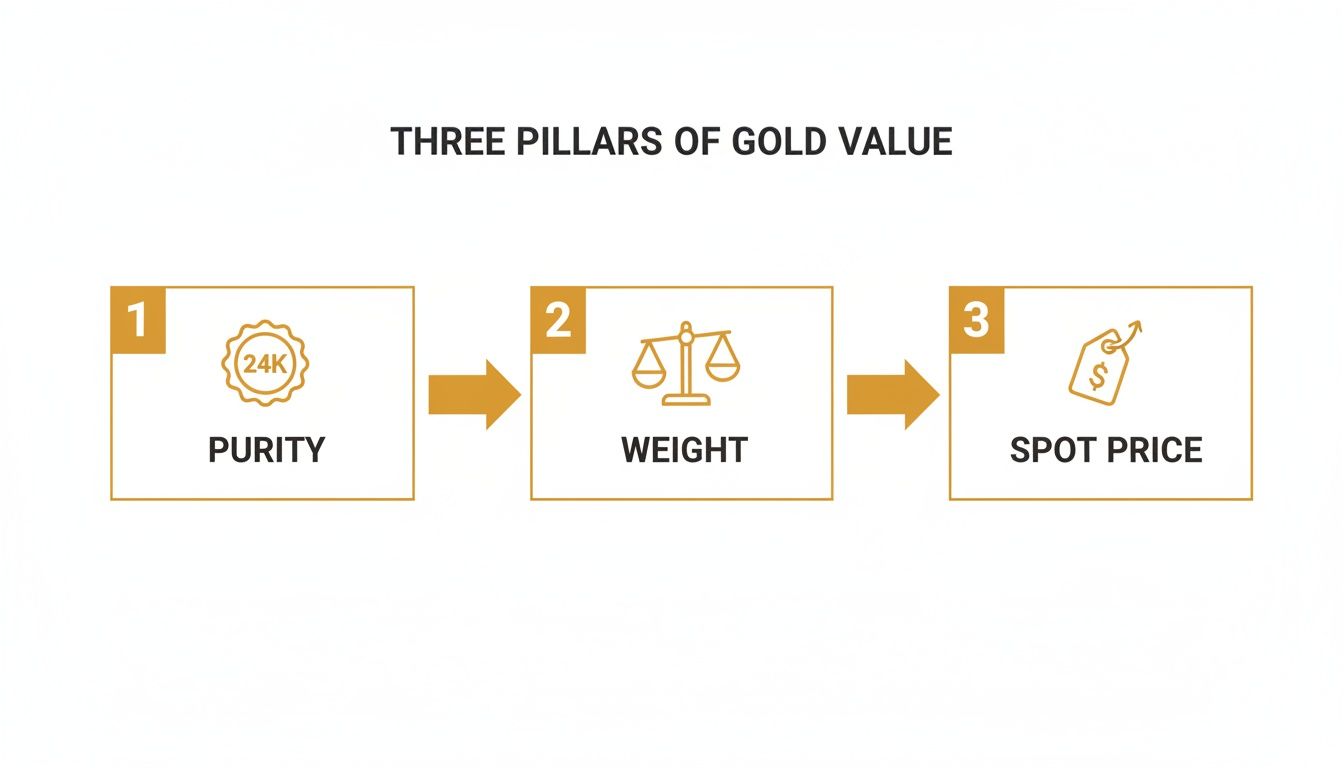
This diagram shows the logical flow perfectly. You start with what you know about your item (its purity and weight) and combine it with live market data (the spot price) to arrive at its value.
Step 1: Find The Current Spot Price Per Gram
First things first, you need to know what the market is paying for gold right now. The live spot price is your starting point. Just remember, it is almost always quoted per troy ounce, but since our necklace is in grams, we will need to do a quick conversion.
Let’s say the live spot price for gold today is $2,350 per troy ounce.
To get the price per gram, we simply divide by 31.1 (the number of grams in one troy ounce).
- $2,350 / 31.1 grams = $75.56 per gram
There it is. For our example, one gram of pure, 24K gold is worth $75.56. This is our baseline number.
Step 2: Calculate The Pure Gold Content
Next up, we need to figure out how much actual gold is in our necklace. It is a 14K piece, so we know it is not 100% pure. As we covered earlier, 14K means the item is 58.3% pure gold (that is 14 divided by 24).
Now we just apply that percentage to the necklace’s total weight.
- 20 grams (total weight) x 0.583 (purity) = 11.66 grams of pure gold
So, while your necklace tips the scales at 20 grams, it only contains 11.66 grams of pure, fine gold. This is the crucial number for determining its raw value.
Step 3: Determine The Total Melt Value
The final step is the easiest. We just multiply the actual gold content by the price per gram we found in Step 1. This gives us the necklace’s total melt value.
- 11.66 grams (pure gold) x $75.56 (price per gram) = $881.13
And there you have it. The full, 100% market value of the raw gold in your 20 gram, 14K necklace is $881.13 on this particular day. If you want to skip the manual math, you can always use a tool like our real-time gold price calculator today for an instant, up to the minute valuation.
It is critical to remember that this “melt value” represents the full market price for the raw metal itself. The actual offer you receive from a buyer will be less than this, and understanding why is the key to setting realistic expectations.
From Melt Value To A Realistic Offer
So, why will not a gold buyer just hand you the full $881.13? Because they are running a business. A gold buyer acts as a middleman, and their job involves costs. They have to collect enough gold, ship it securely to a refinery, pay to have it melted down and purified, and then sell it back into the global market.
This whole process includes expenses like:
- Refining Fees: The refinery charges for its services to melt and purify the gold.
- Business Overhead: This covers everything from rent and insurance to employee salaries.
- Profit Margin: At the end of the day, the buyer needs to make a profit to stay in business.
Because of these built in costs, any reputable buyer will make you an offer that is a percentage of the total melt value. This payout percentage varies between buyers but typically falls in the 70% to 95% range.
Here is how that math shakes out using our necklace example:
| Buyer Offer Percentage | Calculated Payout |
|---|---|
| 70% of Melt Value | $881.13 x 0.70 = $616.79 |
| 85% of Melt Value | $881.13 x 0.85 = $748.96 |
| 95% of Melt Value | $881.13 x 0.95 = $837.07 |
Having this breakdown in your back pocket is a massive advantage. You can walk into any negotiation knowing exactly what your gold is worth on the open market, which makes it incredibly easy to spot a fair offer and sell with total confidence.
A Practical Guide to Gold Karats and Purity
That tiny little stamp on your gold jewelry, the karat mark, is its purity signature. It is one of the most critical factors in figuring out what your gold is worth, as it tells you exactly how much pure gold is in the item.
Understanding these markings is surprisingly simple once you get the hang of it. The whole system is based on a scale of 24 parts. Think of it like a pizza sliced into 24 pieces. 24 karat (24K) gold is the whole pizza; it is pure gold. But pure gold is incredibly soft, making it a poor choice for jewelry that needs to stand up to daily life. This is why other metals are mixed in to create stronger, more durable alloys.
Why 24K Gold Is Rarely Used in Jewelry
While 24K gold is 99.9% pure, its softness makes it easy to scratch, dent, and bend out of shape. Imagine trying to wear a ring made of soft clay; it just would not last. To solve this, jewelers mix in stronger metals like copper, silver, nickel, and zinc to create alloys that can handle the bumps and scrapes of everyday wear.
This is why you will almost always see jewelry marked as 18K, 14K, or 10K. Those lower numbers just mean there is a smaller proportion of pure gold compared to the other metals that give it strength. It is the perfect blend of rich color and real world resilience.
Decoding Common Karat Stamps
The karat stamp on your piece reveals the exact ratio of pure gold to its alloy metals. A higher karat number means a higher percentage of pure gold, and naturally, a higher value.
To make this crystal clear, here is a quick reference guide that connects each karat marking to its actual gold content and what it is typically used for.
Gold Karat Purity and Common Uses
This table is a handy cheat sheet for understanding the most common gold purities you will encounter.
| Karat | Purity (Percentage) | Fineness Stamp | Common Uses | Durability |
|---|---|---|---|---|
| 24K | 99.9% | 999 | Investment coins, bars, bullion | Very Soft |
| 18K | 75.0% | 750 | Fine jewelry, high end watches | Good |
| 14K | 58.3% | 583 or 585 | Most popular for U.S. jewelry | Very Good |
| 10K | 41.7% | 417 | Entry level gold jewelry, durable pieces | Excellent |
As you can see, a 14K piece contains 58.3% pure gold, while an 18K piece is made of 75% pure gold. This difference is precisely why two items that look identical can have wildly different values. The rest of the material is just alloy metals, which have little to no impact on the item’s melt value.
What If My Gold Has No Markings?
Do not panic if you cannot find a stamp. Markings on older rings or heavily worn pieces can easily wear off over time. Sometimes, custom made jewelry was never stamped in the first place. Just because there is no mark does not automatically mean it is not real gold.
If you find yourself in this situation, here are a few things you can do:
- Inspect Closely: Grab a magnifying glass and check for faint markings in hidden spots, like the inside of a clasp or near the post of an earring.
- Look for Discoloration: Real gold does not tarnish or rust. If you see spots of green or black, especially where the metal touches your skin, it is likely gold plated.
- Seek Professional Testing: The only way to know for sure is to have it tested. Any jeweler or reputable gold buyer can perform a simple acid test to determine the exact karat without damaging your item.
The most reliable way to identify unmarked gold is through a professional appraisal. An expert can quickly verify the purity, giving you a definitive answer and peace of mind.
If you are curious about how these verification methods work, our guide to professional gold purity testing breaks down the different techniques. A little bit of knowledge here can make you feel much more confident when it is time to get an offer.
When Your Gold Is Worth More Than Its Weight
While melt value gives you a fantastic baseline for your gold’s worth, it really only tells part of the story. Sometimes, a piece of jewelry is worth far more than the raw metal it is made from. This happens when your item has a higher resale value than its melt value.
Think of it this way: a blank canvas has some basic value based on its materials. But if that canvas holds a painting by a famous artist, its value skyrockets. The exact same principle applies to gold. Understanding this difference is the key to making sure you do not accidentally sell a precious heirloom for its simple scrap price.
Melt Value vs. Resale Value
The melt value is the raw, intrinsic worth of the pure gold in your item, calculated from its weight and the current spot price. It is what a refinery would pay to melt it down into a simple block of metal.
On the other hand, the resale value is what someone would pay to own and wear the item exactly as it is. This value is driven by factors that go way beyond the metal itself. If your piece has a high resale value, you are often much better off selling it to a jeweler, collector, or even directly to another consumer, not a scrap gold buyer.
Factors That Add Premium Value
So, what gives a piece of gold that extra sparkle of value? Several key factors can lift an item’s worth far beyond what the scale says. If your jewelry has any of these characteristics, it almost certainly deserves a detailed appraisal from a specialist, not just a quick weigh in from a standard gold buyer.
Here are the most important things that create a higher resale price:
- Designer Brands: A piece from a top tier designer like Cartier, Tiffany & Co., or Van Cleef & Arpels carries a huge brand premium. People are paying for the name, the legacy, and the iconic design just as much as the gold.
- Antique or Historical Significance: Is your item an antique? Pieces from specific eras (like Art Deco or Victorian) are highly sought after by collectors for their unique style, craftsmanship, and rarity.
- High Quality Gemstones: The presence of valuable diamonds, emeralds, sapphires, or rubies adds another layer of value entirely. The quality, size, and cut of these stones need to be assessed separately from the gold.
- Exceptional Craftsmanship: Intricate designs, detailed enamel work, or unique artisan techniques can turn a piece of jewelry into a work of art, dramatically increasing its desirability and price.
Recognizing these attributes is critical. Selling a signed designer bracelet for its melt value is like selling a classic car for its scrap metal price; you would be leaving a massive amount of money on the table.
This simple table can help you visualize the two different approaches.
| Aspect | Melt Value Focus | Resale Value Focus |
|---|---|---|
| Primary Driver | Gold content (weight and purity) | Brand, design, and craftsmanship |
| Best Buyer | Gold refineries, scrap buyers | Jewelers, antique dealers, collectors |
| Example Item | A broken 14K gold chain | A vintage Rolex watch |
| Key Question | How much raw gold is here? | Who made this and how rare is it? |
Figuring out which category your item falls into is the first step toward choosing the right sales path and getting the best possible price. Always inspect your pieces for designer stamps, unique features, or quality gems before just assuming it is “scrap” gold.
How to Sell Your Gold Safely and Confidently
When it comes to selling gold, knowledge is your greatest asset. The key to a good sale is not just knowing what your gold is worth, but also understanding how to navigate the selling process itself. A little preparation can make a huge difference, giving you the power to size up offers intelligently and pick a buyer with total confidence.
Walking in prepared means you stay in control of the transaction from beginning to end. It is about doing a bit of homework before you ever ask for an offer, turning a potentially confusing situation into a straightforward deal where you feel secure and respected.
Your Pre Sale Checklist
Before you start hunting for offers, take a few minutes to get everything in order. Running through these simple steps will streamline the whole thing and help you spot a fair deal when you see one. Think of it as your game plan for getting the best possible price.
Here is a quick checklist to get you ready:
- Calculate Your Estimated Value: Use the steps we just covered to figure out your gold’s melt value. This number, based on weight, purity, and the live spot price, is your benchmark for every offer you get.
- Sort Your Items by Karat: Group your 10K, 14K, and 18K pieces together. Keeping them separate makes the appraisal process much faster and more transparent, as the buyer can weigh and assess each purity level on its own.
- Take Clear Photos: If you are planning to get quotes online, good pictures are a must. Snap clear photos of your items, making sure to capture any hallmarks or designer stamps. This helps buyers give you a more accurate preliminary offer.
Finding a Trusted Buyer
Let’s be clear: not all gold buyers are created equal. The difference between a great price and a terrible one often comes down to who you sell to. That is why it is always smart to shop around and get multiple offers before you commit.
A reputable buyer will be totally transparent about their process. They should weigh your gold right in front of you, clearly explain their payout percentage, and never pressure you into making a decision on the spot.
To make sure your sale is both safe and profitable, keep an eye out for red flags. High pressure sales tactics, offers that seem way too good to be true, or a buyer who gets cagey when you ask how they price things are all signs to walk away. For a deeper dive, check out our complete guide on finding the best place to sell gold, which breaks down all your options.
Here is a quick rundown of common buyer types and what you can generally expect:
| Buyer Type | Payout Percentage (Typical) | Pros | Cons |
|---|---|---|---|
| Local Jewelers | 70% to 85% | Convenient, face to face service | Payouts can vary widely |
| Pawn Shops | 50% to 75% | Very fast, immediate cash | Often offer the lowest prices |
| Online Gold Buyers | 80% to 95% | Often the highest payouts | Requires shipping your items |
| Refineries | Up to 98% | Highest possible return | Usually require large quantities |
By comparing offers from at least two or three different buyers, you give yourself the best shot at securing a fair price. This little bit of due diligence protects you from lowball offers and ensures you are dealing with a trustworthy business. This is the final step in confidently answering the question “what is my gold worth?” with real cash in hand.
Common Questions About Finding Your Gold’s Value
We have covered a lot of ground, but you might still have a few things on your mind. Asking “what is my gold worth?” often brings up some specific follow up questions, so let’s tackle the most common ones we hear. This way, you will feel completely prepared for whatever comes next.
Why Is a Buyer’s Offer So Much Lower Than the Spot Price?
This is, without a doubt, the number one question people ask. The answer comes down to simple business economics. Think of the spot price as the wholesale cost for pure, raw gold traded in huge quantities on the global market.
A local gold buyer or online refiner is a middleman. They have to purchase your items, process them, and cover all their own costs before they can sell the refined gold back into that market.
Their offer has to account for these real world expenses:
- Refining Fees: The cost to melt down your jewelry and purify the gold back to its raw form.
- Operational Costs: Everyday business expenses like rent, insurance, secure shipping, and paying their staff.
- Profit Margin: Just like any business, they need to make a small profit to stay open.
A realistic offer from a reputable buyer will typically fall between 70% to 95% of the melt value. Anyone offering less is probably taking too big a cut, but an offer of 100% is a major red flag. A transparent buyer will be happy to explain their process.
What’s the Difference Between a Troy Ounce and a Regular Ounce?
You have probably noticed that precious metals are weighed in troy ounces, while almost everything else in the US, from groceries to packages, uses a standard (or avoirdupois) ounce. It is a small but critical difference: the troy ounce is slightly heavier.
Here is a simple breakdown to keep them straight.
| Unit | Weight in Grams | What It Is Used For |
|---|---|---|
| Troy Ounce (ozt) | 31.1 grams | Precious metals like gold, silver, and platinum. |
| Regular Ounce (oz) | 28.35 grams | Groceries, shipping, and most everyday items. |
The most important thing to remember is that the live gold price you see online is always quoted per troy ounce. Make sure your calculations use the right conversion!
Does the Color of My Gold Affect Its Value?
Nope, not at all. The color of gold has zero impact on its fundamental value. Whether your jewelry is classic yellow, modern white, or trendy rose gold, its worth is based purely on two things: its gold content (karat) and its weight.
The different colors are just the result of mixing pure gold with different metal alloys. For instance, rose gold gets that beautiful pinkish tone from a higher amount of copper in the mix. White gold is typically alloyed with white metals like palladium or nickel to give it a silvery appearance. At the end of the day, 10 grams of 14K white gold has the exact same amount of pure gold, and the same melt value, as 10 grams of 14K yellow gold.
Ready to stop guessing and find out exactly what your gold is worth? The Gold Calculator gives you a free, instant estimate based on live market prices. Get your accurate valuation in seconds at https://thegoldcalculator.com.