Grams to Troy Ounces Gold: Your Guide to Accurate Conversion
Right away, let’s get straight to the number you need. One troy ounce of gold is exactly 31.1035 grams.
This isn’t just some random figure; it’s the global standard that precious metals markets use for all pricing and trading. Think of it as the universal language for gold valuation. Knowing this single number is the first step toward understanding the true value of your gold.
Your Quick Guide To Gold Weight Conversion
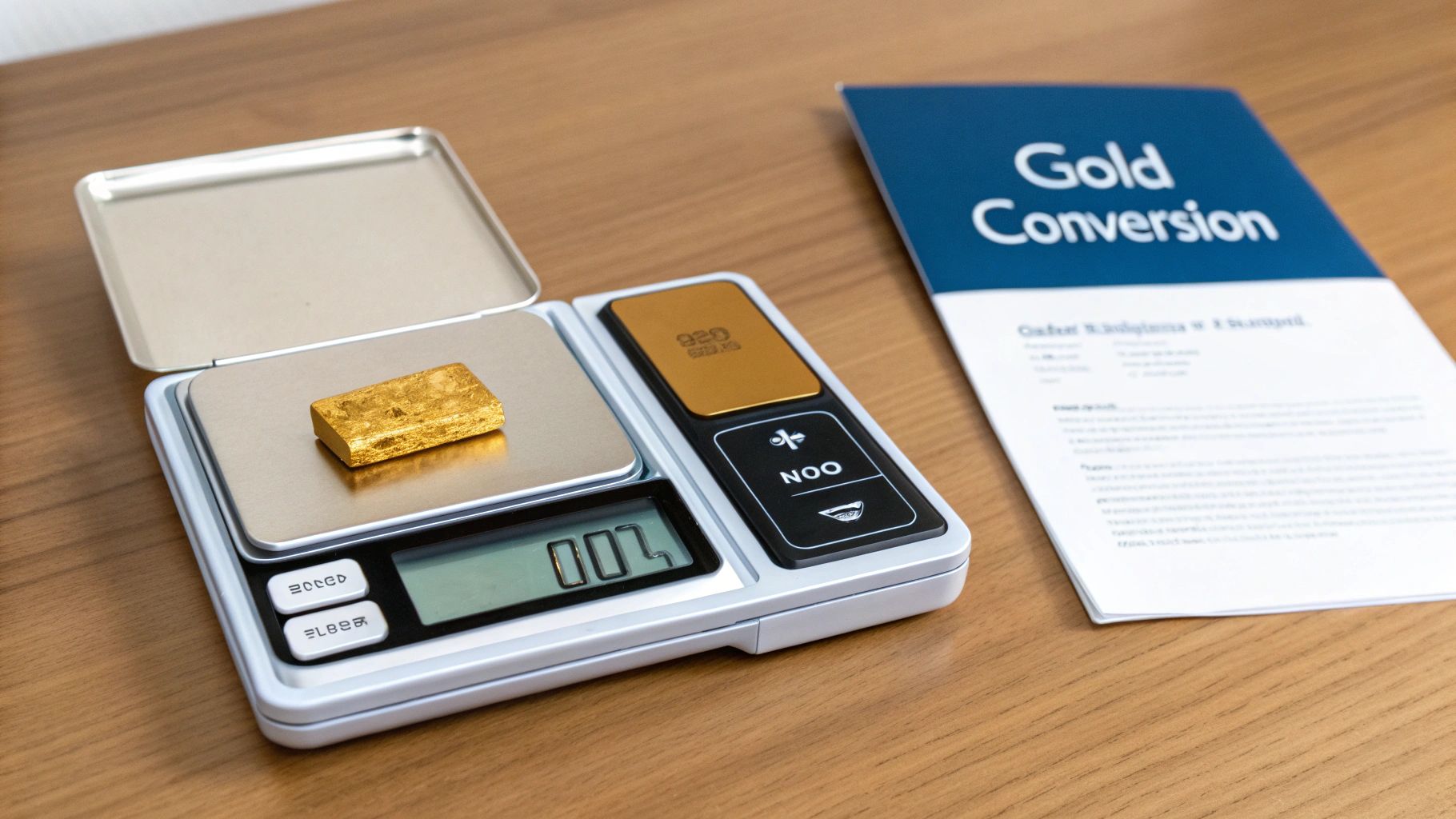
While you might weigh food in regular ounces or your jewelry on a gram scale at home, the entire precious metals industry operates on this specific troy system. Getting this right is the first and most important step to knowing what your gold is actually worth.
Ever wonder why that is? It all comes down to standardization. This precise conversion is the unit used by major exchanges like COMEX and the London Bullion Market Association (LBMA) for setting the daily spot gold price, which ensures total consistency worldwide. In fact, in markets like London and New York, well over 90% of physical gold trades reference this exact conversion, powering billions of dollars in daily volume.
For an everyday seller, getting this wrong means leaving money on the table. A simple 10 gram ring isn’t just 10 grams of value it’s 0.3215 troy ounces. It’s a small distinction with big financial consequences.
Quick Reference Grams To Troy Ounces Conversions
To help you get a quick feel for your own items’ weight in the language of the gold market, we’ve put together a simple reference table. This shows some common gram weights and their direct troy ounce equivalents.
| Weight In Grams (g) | Equivalent In Troy Ounces (t oz) |
|---|---|
| 1 gram | 0.03215 troy ounces |
| 5 grams | 0.16075 troy ounces |
| 10 grams | 0.32151 troy ounces |
| 20 grams | 0.64301 troy ounces |
| 50 grams | 1.60754 troy ounces |
| 100 grams | 3.21507 troy ounces |
This table is a great starting point. Whether you’ve got a single earring or a heavy chain, you can quickly estimate its weight in the unit that truly matters for valuation. In the next sections, we’ll dive into how to use this conversion to calculate your gold’s precise value.
Why Gold Relies On The Troy Ounce
Ever wonder why gold isn’t weighed like bananas at the supermarket? The simple reason is that precious metals play by a different set of rules. This global standard, known as the troy weight system, has ancient roots that go back long before the everyday scale you’re used to.
The history of the troy ounce can be traced all the way back to Roman times. It was later standardized in Troyes, France a major medieval trading hub. This system was created specifically for high value goods like precious metals and gemstones, guaranteeing a consistent and fair measure across different markets long before modern systems came into play.
Avoirdupois vs Troy Ounce What Is The Difference
The critical distinction is the weight itself. The standard or avoirdupois ounce we use for most goods weighs 28.35 grams. A troy ounce, on the other hand, is heavier, weighing in at precisely 31.1035 grams. It might not sound like much, but that difference is huge when you’re dealing with gold. Let’s compare them side by side.
| Measurement Unit | Weight in Grams | Primary Use |
|---|---|---|
| Troy Ounce | 31.1035 g | Precious metals (gold, silver, platinum) |
| Avoirdupois Ounce | 28.35 g | Everyday goods (food, postage) |
This weight difference of nearly 10% is crucial. Confusing a troy ounce with a standard ounce is one of the most common and costly mistakes a seller can make, as it instantly undervalues their gold.
This need for precision is exactly why the troy ounce remains the unshakable standard for gold, silver, and platinum. It ensures that an ounce of gold in New York is identical to an ounce in London or Tokyo, creating a stable and trustworthy global market. To fully grasp why gold is valued so precisely, it helps to understand its broader financial role, including the historical correlation between gold and the stock market.
Sticking to this specific, historical standard isn’t just about tradition. It’s about maintaining universal trust and accuracy in a market where tiny fractions can represent significant value. Knowing this difference equips you to be a much more informed and confident seller.
Calculating Your Gold’s Weight From Grams To Troy Ounces
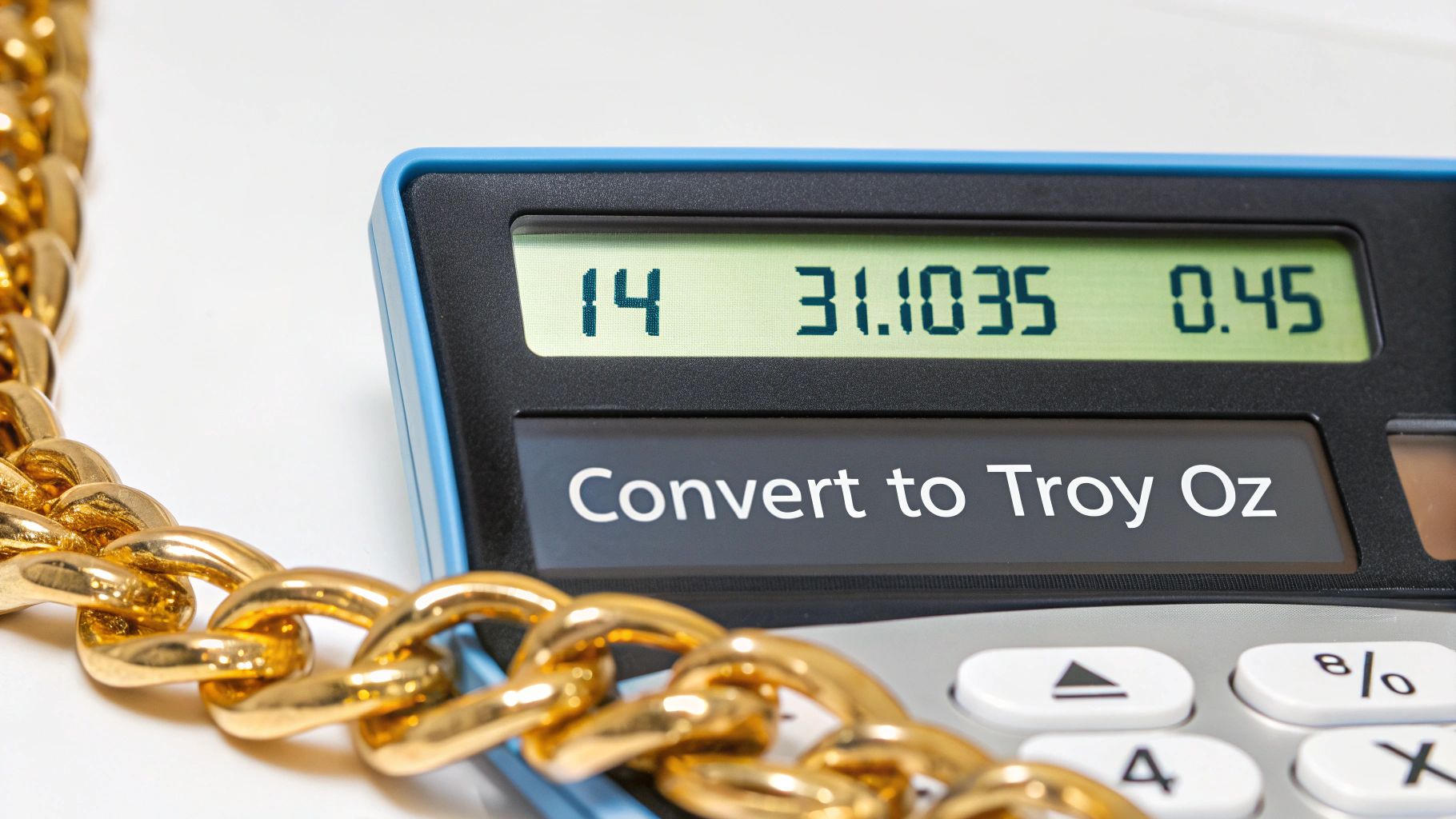
Now that you know why gold is measured in troy ounces, let’s get down to the practical part: doing the conversion yourself. Getting a feel for the math behind the curtain will give you a ton of confidence when you’re evaluating your gold.
The good news? It’s incredibly simple. You don’t need a degree in advanced mathematics, just a basic calculator.
All you have to do is take your item’s weight in grams and divide it by 31.1035. That’s the magic number that bridges the gap between a standard digital scale and the world of precious metals pricing.
The Conversion Formula:
Weight in Grams / 31.1035 = Weight in Troy Ounces
Let’s run through a real world scenario. Say you have an old gold chain and you pop it on your kitchen scale. It reads 14 grams.
To figure out its weight in troy ounces, you just plug the numbers in:
14 / 31.1035 = 0.4501 troy ounces. Simple as that.
Let’s Try Another Example
To really lock it in, let’s take another common piece maybe a single gold earring you found at the bottom of a jewelry box. You weigh it and find it’s exactly 5 grams.
We’ll use the exact same formula:
- Weight in Grams: 5 g
- Calculation: 5 / 31.1035
- Result: Approximately 0.1607 troy ounces
This one little division is the heart of every single gram to troy ounce calculation for gold. Once you get this, you can quickly check any quote you’re given and make sure everything lines up. If you’re interested in the other factors that play a role in the total value, you can explore the full picture in our guide to the gold calculation formula.
A Quick Tip On Rounding
Here’s a pro tip from years of experience: don’t round your numbers too early in the process. Gold is a high value commodity, and those tiny fractions of a troy ounce can translate into real dollars and cents.
Keep all the decimal places your calculator shows you until the final step when you’re calculating the actual monetary value. This small habit ensures you’re working with the most precise weight possible. While the math is straightforward, modern calculators automate this to guarantee perfect accuracy every time you need it.
From Weight and Purity to Cold, Hard Cash
Knowing your gold’s weight in troy ounces is a great start, but it’s only half the story. The next critical piece of the puzzle is its purity, or karat. After all, a 14K gold ring isn’t pure gold, so you can’t base its value on its total weight.
This is where we connect the dots between weight, purity, and the live market price to find your item’s true melt value. Most jewelry isn’t 24K (pure gold). It’s actually an alloy a metal blend mixed with others like copper or silver to make it tough enough for daily wear.
What Your Karat Stamp Really Means
That little karat marking stamped on your jewelry tells you exactly how much pure gold it contains. The system is pretty simple: it’s based on parts out of 24, where 24K is 100% pure gold.
Here’s a quick breakdown of what the most common markings mean for your item’s actual gold content:
- 10K Gold: This means your piece is 10 parts gold and 14 parts other metals, making it 41.7% pure gold.
- 14K Gold: A very popular choice, this is 14 parts gold and 10 parts other metals, or 58.3% pure gold.
- 18K Gold: This high quality blend is 18 parts gold and 6 parts other metals, which works out to 75% pure gold.
This purity percentage is the key to finding out how much of your item’s weight is actually gold. For instance, a 10 gram 14K ring only contains 5.83 grams of pure, valuable gold. The rest is just alloy.
Using a Gold Calculator for an Instant Valuation
Once you know the weight in grams and the karat, you have everything you need to calculate a precise melt value. This is where a specialized tool really shines.
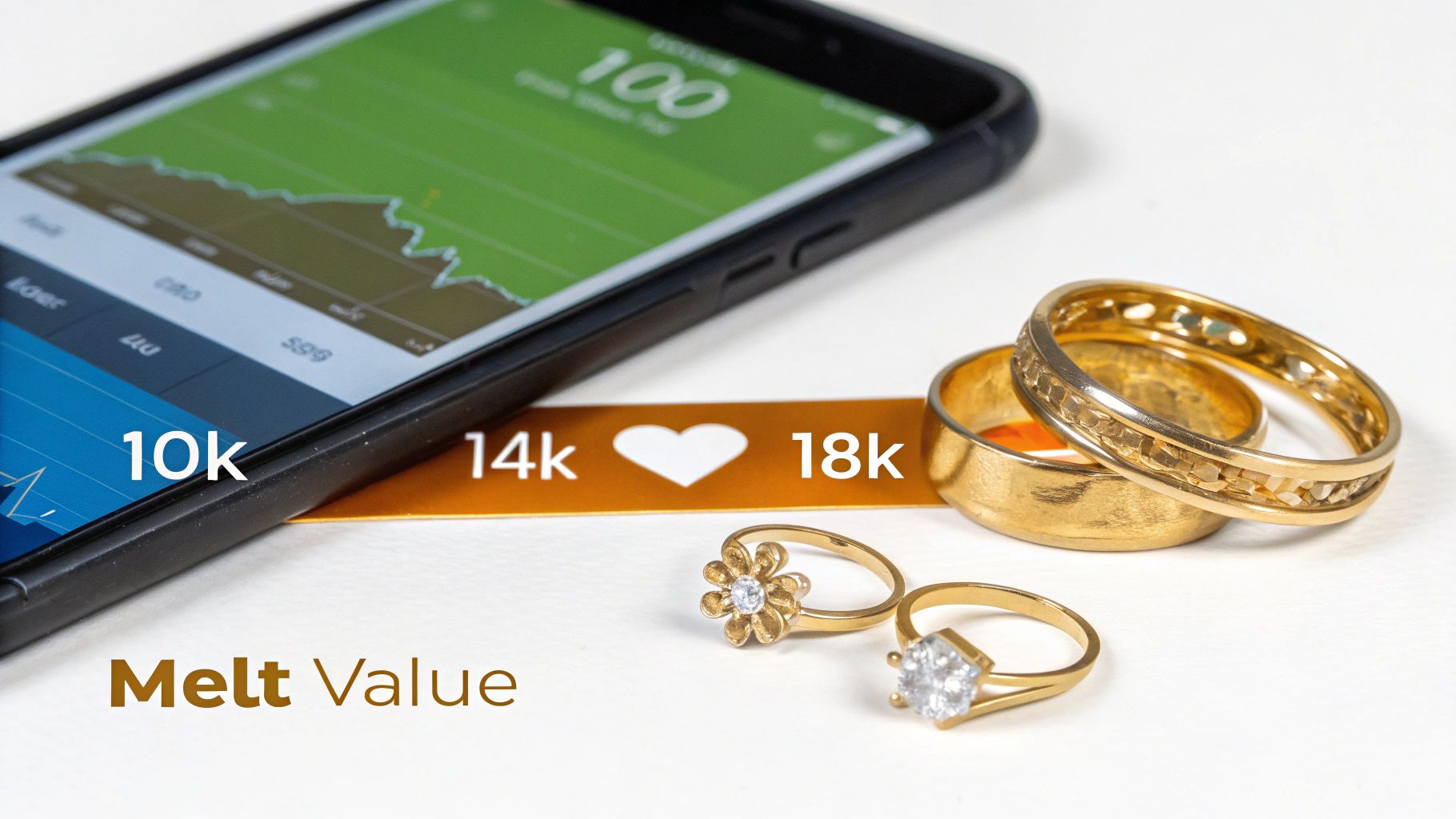
You can use a tool like our gold price calculator to get an instant, accurate valuation based on live market data.
Just pop in the weight in grams, select the correct karat from the dropdown menu, and the calculator does all the heavy lifting. It figures out the pure gold content and multiplies it by the real time spot price, giving you a powerful baseline for what your gold is worth today.
A Quick Word on Payouts and Refining Fees
When you go to sell your gold, the buyer will deduct a refining fee from the melt value to cover their costs and turn a profit. This is standard practice everywhere.
Typically, the final payout you receive will be somewhere between 70% to 95% of the item’s total melt value. Knowing this ahead of time helps you set realistic expectations and negotiate a fair price with confidence.
Common Mistakes To Avoid When Selling Gold

Knowledge is your best defense against a bad deal. When you’re converting grams to troy ounces for gold, you are already ahead of most sellers, but a few common pitfalls can still trip you up and cost you money.
We see the same issues time and again. Knowing what they are beforehand helps you protect your assets and walk away with a fair price. Let’s dig into the top three mistakes we see sellers make.
Accepting A Price Based On The Wrong Ounce
This is by far the most frequent and costly error. Some buyers might quote you a price based on a standard (avoirdupois) ounce instead of a troy ounce. Because a troy ounce is nearly 10% heavier (31.1035g vs 28.35g), this tactic instantly devalues your gold. It’s a subtle but significant difference.
Always confirm that any offer “per ounce” is based on the troy ounce. If a buyer seems evasive about this simple clarification, it’s a major red flag.
The quickest way to spot this issue is to do the math yourself. If the price seems unusually low for the gram weight you have, the buyer might be using the wrong unit of measure.
Confusing Gross Weight With Gold Weight
The second major mistake is forgetting about purity. The total weight of your 14K jewelry on the scale is not its pure gold weight. A piece stamped “14K” is only 58.3% gold; the rest is made up of other metal alloys that add durability.
Many sellers get excited by the total gram weight, but its value is based only on the actual gold content. Any experienced buyer knows this, and so should you.
Walking In Without A Baseline Value
Finally, the most critical mistake is entering a negotiation without a clear idea of your gold’s melt value. Not having a data backed number puts you at a huge disadvantage. It forces you to rely solely on whatever the buyer offers.
This is where a tool like TheGoldCalculator.com becomes essential. By entering your item’s weight in grams and its karat, you get an immediate, unbiased melt value based on live market data. This figure is your negotiation starting point, empowering you to ask for a fair percentage and walk away from lowball offers.
Common Questions About Gold Conversions
Once you get the hang of converting grams to troy ounces, a few follow up questions almost always come up. Getting these details straight can make a real difference in how accurately you value your gold. Let’s clear up some of the most common points of confusion we see.
How Many Grams Are In A Troy Ounce Of Gold?
There are exactly 31.1035 grams in a single troy ounce of gold. This is the non negotiable standard used by precious metals markets all over the world. It’s absolutely critical not to mix this up with a regular ounce (an avoirdupois ounce), which is much lighter at about 28.35 grams. Using the wrong one will throw your numbers way off.
Why Is My 10 Gram 14K Gold Chain Not Valued At The Price Of 10 Grams Of Pure Gold?
This is probably the most common question people have when valuing jewelry. A 14K gold chain is only 58.3% pure gold (that’s 14 parts gold out of 24). The other 41.7% is a mix of other metals like copper or silver, which are added to make the chain strong enough for daily wear but don’t contribute to its melt value.
So, when a jeweler values your chain, they’re only looking at the pure gold content. For a 10 gram chain, that’s just 5.83 grams (10 grams x 0.583), not the full 10 gram weight. Any good calculator will automatically do this math for you when you select the karat.
Understanding this difference between the total weight and the actual gold content is the single most important concept for getting a fair price. The value is always in the pure gold, not the alloys mixed in.
Do I Need A Special Scale To Weigh My Gold In Troy Ounces?
Nope, you don’t need a special scale at all. In fact, pretty much every common digital scale measures in grams, and that’s exactly what you want.
The standard practice in the industry is to weigh everything in grams first. From there, you just use the conversion formula (grams / 31.1035) or an online tool to figure out the troy ounce equivalent and its value. This is how professional gold buyers and jewelers do it every day.
Ready to find out what your gold is worth with pinpoint accuracy? The Gold Calculator gives you an instant, transparent valuation based on live market data. Just enter your gold’s weight and purity to get a reliable estimate in seconds. Visit TheGoldCalculator.com to calculate your gold’s true value now.