How much is 500 grams of gold worth? Live Prices, Purity & Buyer Costs
Ever wondered what 500 grams of gold is actually worth?
The short answer is its value is always shifting, but as of recently, the theoretical melt value for 500 grams of pure 24k gold hovers around $37,000. That’s a significant number, but it’s just the starting point. The cash you’ll actually see in your hand depends on the gold’s purity and the price a buyer is willing to pay. This guide will walk you through all the factors so you can understand the real world value of your gold.
The True Value of 500 Grams of Gold Explained
When you ask, “how much is 500 grams of gold worth,” you’re tapping into a global market that plays by its own set of rules. The biggest rule to wrap your head around is how gold is priced. You might be holding your gold in grams, but the international market speaks a different language: the troy ounce.
This detail is absolutely essential because every gold valuation starts from this unit. To figure out the real value of your 500 grams, you have to translate it into the market’s preferred language first.
From Grams to Troy Ounces: The First Step
A troy ounce is the traditional unit for weighing precious metals, and it’s a bit heavier than a standard ounce, clocking in at approximately 31.1035 grams. This is a key piece of data for any calculation.
So, your first step is a simple conversion:
500 grams is equal to about 16.08 troy ounces (500 ÷ 31.1035).
This conversion is the bedrock of your calculation. For example, if the live market price, or “spot price”, of gold is $2,300 per troy ounce, the math would put the base value of your pure gold at roughly $37,000. In the real world, though, sellers almost never get 100% of the spot price. Most retail buyers will offer between 70% and 95% of this theoretical value to cover their own costs and profit.
How Purity Dramatically Affects the Final Price
The second major piece of the puzzle is purity. Pure gold, known as 24 karat (24k), is surprisingly soft. To make it strong enough for jewelry that can withstand daily life, it gets mixed with other metals like copper, silver, or zinc. This mixture is called an alloy.
This is where the karat system comes in. It’s simply a measure of how much pure gold is in your item.
For example, 18k gold is 75% pure gold, while 14k gold is only 58.3% pure. This means a 500 gram chunk of 14k gold contains a lot less actual gold than a 500 gram 24k bar, and that difference directly hammers its melt value.
To give you a clearer picture, the table below breaks down how the estimated value of 500 grams of gold changes based on its purity.
Estimated Melt Value of 500 Grams of Gold by Purity
This table shows the approximate melt value of 500 grams of gold at different purity levels, based on a hypothetical spot price of $2,300 per troy ounce.
| Purity (Karat) | Fineness | Pure Gold Content (Grams) | Estimated Melt Value |
|---|---|---|---|
| 24k | .999 | 500.0 g | $36,960 |
| 22k | .916 | 458.0 g | $33,855 |
| 18k | .750 | 375.0 g | $27,720 |
| 14k | .585 | 292.5 g | $21,621 |
| 10k | .417 | 208.5 g | $15,411 |
As you can see, the drop off is steep. The difference between a 24k bar and a 10k item of the same weight is over $20,000, which underscores just how critical purity is in any gold valuation.
How to Calculate the Melt Value of Your Gold
Figuring out the raw value of 500 grams of gold isn’t some secret art reserved for experts. It’s actually a surprisingly simple, three step formula that anyone can master. Once you break it down, you’ll be able to confidently estimate what your gold is worth.
It all boils down to three key pieces of information: its weight, its purity, and the current market price for gold. Get those three things, and the rest is just simple multiplication. This process puts you in the driver’s seat, letting you know the true baseline value of your asset before you even talk to a buyer.
The Three Essential Steps to Valuation
To find the melt value of your gold, you just need to follow a logical sequence. Think of it like a simple recipe. Each ingredient is crucial, and when you put them together correctly, you get the final result.
Here’s the process from start to finish:
- Confirm the Weight: First things first, get an accurate weight. Use a digital scale to find the exact weight of your gold item in grams. Precision really matters here, as even a tiny difference can swing the final value quite a bit.
- Determine the Purity: Next, check your item for any hallmarks that indicate its karat, like “18k” or “750.” This number tells you what percentage of your item is pure gold, which is absolutely critical for the next step.
- Find the Spot Price: Finally, look up the live spot price of gold. This price is almost always quoted per troy ounce, so you’ll need to convert it to a price per gram. The magic number for that conversion is 31.1035. Just divide the troy ounce price by that figure.
This visual flow shows how you go from weighing your gold to finding its actual monetary value.
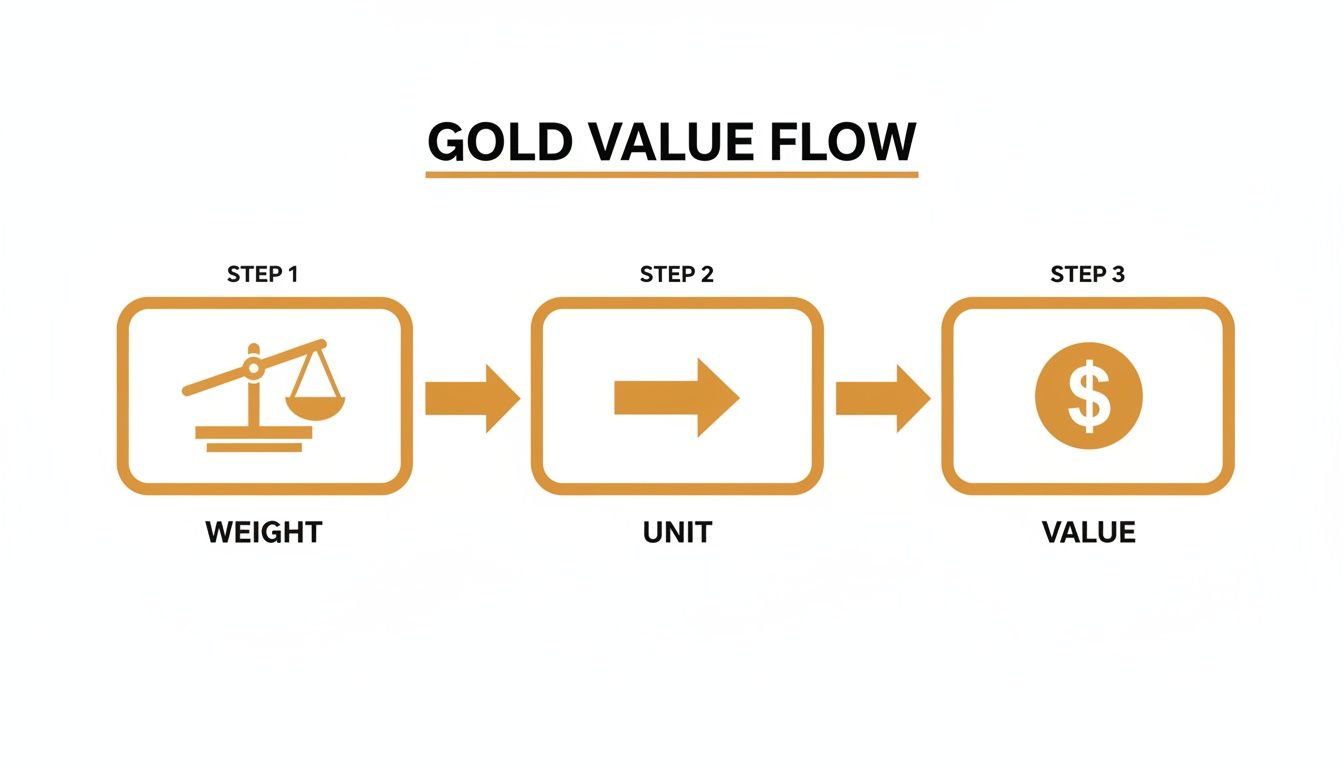
As the diagram shows, it’s a straightforward journey: weigh the item, figure out its pure gold content based on its purity, and then multiply that by the current market rate.
A Practical Calculation Example
Let’s walk through this with a real world item: an 18k gold chain that weighs exactly 500 grams. The first thing we need to know is how much of that is actual gold.
Since 18k gold is 75% pure, the calculation is simple:
500 grams (total weight) x 0.75 (purity) = 375 grams of pure gold
Okay, so we have 375 grams of pure gold. Now, let’s say the spot price of gold today is $75 per gram. To get the melt value, you just multiply the pure gold content by that price.
The final step looks like this:
375 grams (pure gold) x $75 (price per gram) = $28,125
So, the theoretical melt value for that 500 gram 18k gold chain would be $28,125. This is the number that every buyer uses as their starting point. If you want to dive deeper into these calculations, check out our comprehensive gold melt value calculator guide for more examples.
Of course, nobody wants to do this math every single time. That’s exactly why we built the Gold Calculator. It automates all these steps for you, using live prices to give you an instant, accurate valuation without any of the manual work.
Understanding Gold Purity and Why It Matters
When you’re trying to figure out how much 500 grams of gold is worth, its weight is only half the story. The other, equally critical piece of the puzzle is its purity. Not all gold is created equal, and the difference between an 18k necklace and a 24k bar will cause a massive swing in your final valuation.
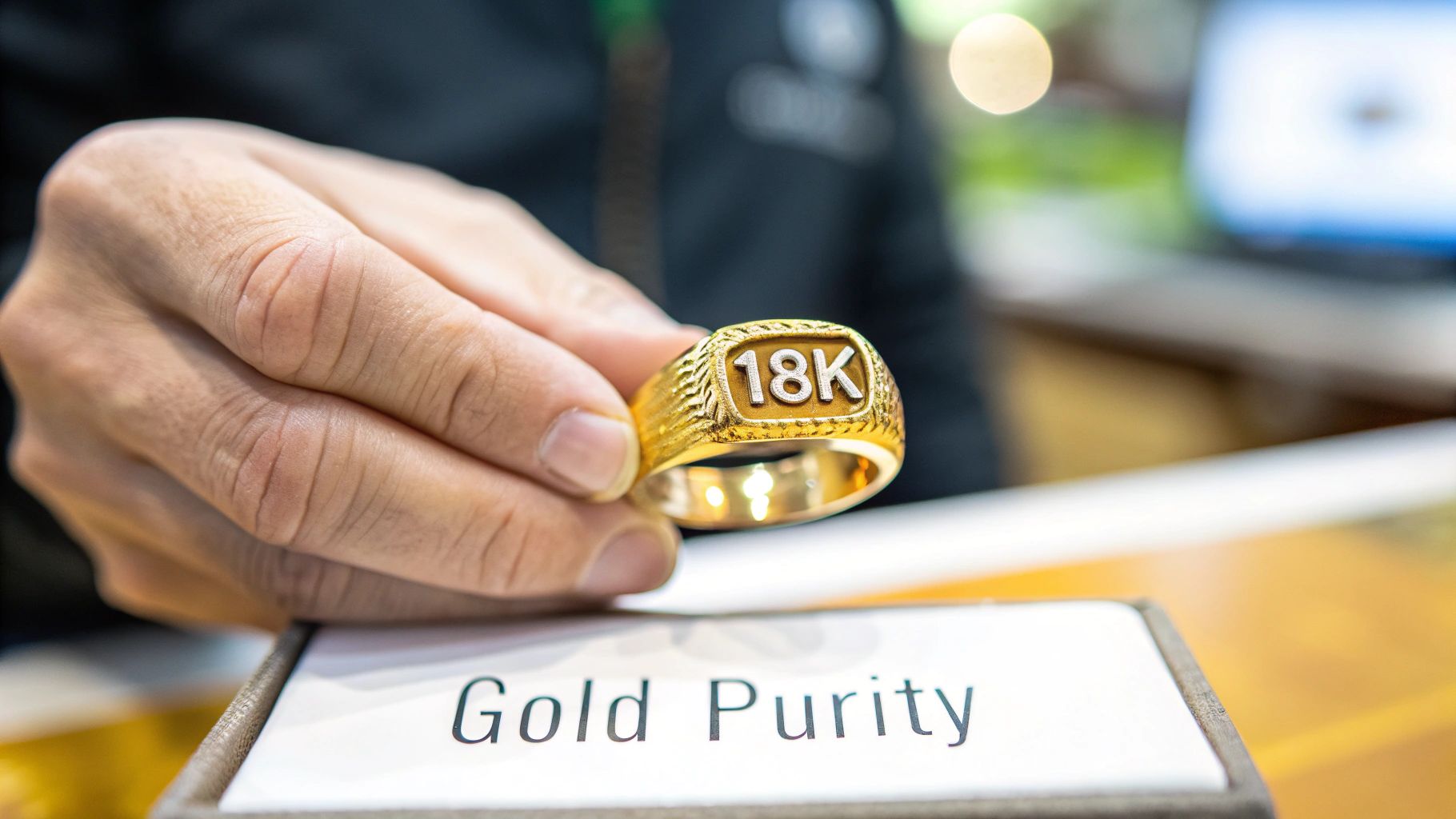
Think of it like mixing juice concentrate. Pure, 24 karat (24k) gold is the potent, undiluted concentrate. But on its own, it’s actually quite soft. It’s too soft for things like jewelry that need to stand up to daily life. To give it the strength to resist scratches and dents, it’s mixed with other metals like copper, silver, or zinc. This blend is called an “alloy,” and the purity level simply tells you how much pure gold is in that mix.
From Karats to Fineness
The karat system is the most familiar way people talk about gold purity. It’s a simple scale that measures purity in parts out of 24. For instance, 24k gold is the real deal. It’s 99.9% pure gold.
You might also come across another system called fineness, which measures purity in parts per thousand. It’s often stamped on bullion bars and coins, but it’s just as easy to understand once you see the two systems side by side.
Here’s a quick breakdown of the common purity levels you’ll most likely encounter.
| Karat (k) | Fineness | Pure Gold Content | Common Use |
|---|---|---|---|
| 24k | .999 | 99.9% | Bullion bars, coins |
| 18k | .750 | 75.0% | High end jewelry |
| 14k | .585 | 58.5% | Standard US jewelry |
| 10k | .417 | 41.7% | Durable, affordable jewelry |
This is precisely why purity is so important. The melt value of your 500 gram item is based only on its pure gold content. A buyer isn’t paying for the copper or zinc mixed in; they’re paying for the gold itself.
This means that 500 grams of 14k gold (which contains 292.5 grams of pure gold) will be worth significantly less than 500 grams of 18k gold (which contains 375 grams of pure gold).
Finding Purity Marks on Your Items
So, how do you figure out the purity of your gold? The good news is that most commercially made gold items are stamped with a tiny marking called a hallmark. You’ll usually find them in discreet spots, like the inside of a ring’s band or on the clasp of a necklace.
You’ll need to look closely for these little numbers. Here’s what to look for:
- “18k” or “750” for 18 karat gold.
- “14k” or “585” for 14 karat gold.
- “10k” or “417” for 10 karat gold.
Finding this hallmark is the first step toward getting an accurate price check. If you can’t find a stamp, or if you’re not sure it’s authentic, you might need to get the item professionally tested. You can learn more in our detailed guide on the different methods of gold purity testing. Nailing down the correct purity ensures you’re starting your calculation with the right numbers.
Spot Price vs. Cash in Hand: What You Actually Get Paid
So you’ve done the math, you know the spot price, and you have a solid number for the melt value of your gold. This is the moment that catches a lot of first time sellers by surprise. The figure you calculated is the theoretical market value, but it’s almost never the exact amount a buyer will hand you.
The real question isn’t just “how much is 500 grams of gold worth?” It’s “how much of that value will I actually get to keep?”
It’s extremely rare for any buyer, be it a jeweler, refiner, or pawn shop, to pay 100% of the spot price for scrap gold. Instead, you should expect offers that land somewhere between 70% and 95% of the melt value. This isn’t a bait and switch; it’s just the business reality of turning raw gold back into a usable commodity.
Why Buyers Can’t Pay the Full Price
Try looking at the transaction from the buyer’s side for a moment. When they buy your gold, they take on a whole host of costs before they can see a single dollar of profit. The percentage they keep, often called their “spread,” is what covers these operational necessities.
Here’s a quick rundown of what that spread pays for:
- Refining Fees: Your gold isn’t ready to be reused as is. It has to be melted down and purified in an industrial process to separate it from other metals, and that service isn’t free.
- Assaying and Testing: Buyers need to be absolutely certain of the gold’s purity. Verifying it requires expensive, specialized equipment and trained staff.
- Insurance and Security: Holding and moving large amounts of gold is risky. The costs for secure storage and insured transport are significant.
- Operational Overhead: This bucket includes all the standard costs of running a business, like rent for their storefront, employee salaries, and utilities.
- Market Risk: The price of gold is always moving. A buyer faces the risk that the spot price could drop between the moment they buy your gold and the time they sell it to a larger refiner.
Because of these very real costs, a buyer’s offer has to account for their business expenses. A good, reputable buyer will be upfront about the percentage they pay, which helps you understand exactly how they arrived at their offer.
The real cash you receive for 500 grams of gold depends on purity, local spreads, and market volatility. These factors can easily change the effective value by 10% to 30%.
The Massive Impact of Payout Percentages
A few percentage points might not sound like a big deal, but when you’re talking about a substantial amount like 500 grams, the difference can be staggering. The payout percentage a buyer offers is arguably the single most important factor determining your final cash offer.
Let’s put it into perspective with an example. If the melt value of your gold is calculated at $37,000, a competitive refiner paying 95% would offer you around $35,150. That’s a solid offer.
But another buyer paying a lower rate of 75% would offer closer to $27,750. That’s a jaw dropping gap of over $7,000 for the exact same pile of gold. You can dive deeper into how pages that track gold prices closely calculate these values and what moves the market.
Understanding this gap is your biggest advantage. It empowers you to shop around, compare offers, and instantly recognize what a fair price actually looks like.
How Gold Prices Have Changed Over Time
Knowing what your gold is worth today is one thing, but zooming out to see how its value has behaved over time gives you a much richer perspective. The answer to “how much is 500 grams of gold worth?” has swung dramatically over the decades, which is exactly why so many people see it as a reliable way to store wealth. Gold’s price isn’t just a line on a chart; it’s a story of major economic shifts and gold’s unique role as a safe haven asset.
If you look back, the transformations are incredible. For instance, in the early 1800s, the official price of gold was fixed at just $19.39 per troy ounce. At that price, 500 grams of gold was worth a mere $311.
Now, fast forward to the intense financial pressure of 2011. Gold’s price rocketed towards $1,900 an ounce, and that same 500 gram bar would have been worth around $30,500. Seeing these major shifts in historical gold prices really drives home how global events shape its value.
Gold’s Performance During Economic Stress
Time and again, gold has proven its mettle when other assets start to crumble. Its reputation is well earned, and a couple of key periods really highlight this.
The 1970s is a classic example. The old Bretton Woods system, which tied the U.S. dollar to gold, collapsed in 1971. Once that link was broken, the price of gold took off. It climbed from about $35 per ounce to over $600 by its peak in 1980, a staggering increase of more than 1,600% in under a decade. This showed everyone its power during times of high inflation and currency chaos.
More recently, the 2008 financial crisis and the European debt crisis that followed in 2011 put gold back in the spotlight. As investors scrambled to get out of volatile stocks and shaky currencies, they poured their money into gold, pushing its price to record highs.
This history lesson matters for any seller. It confirms that gold isn’t just a shiny metal; it’s a financial instrument with a long, proven track record of protecting wealth when it matters most. The table below puts the journey of 500 grams of gold into stark relief.
| Time Period | Price Per Troy Ounce (Approx.) | Value of 500 Grams of Gold (Approx.) |
|---|---|---|
| Early 1800s | $19.39 | $311 |
| 1971 | $35 | $563 |
| 1980 Peak | $615 | $9,891 |
| 2011 Peak | $1,900 | $30,552 |
| Today | Varies | See Live Calculator |
Find Your Gold’s Instant Value with Our Free Calculator
We’ve covered a lot of ground in this guide, breaking down all the moving parts that determine what 500 grams of gold is really worth. You now see that the final number comes from a mix of weight, purity, and the live market spot price. We’ve also seen how the actual payout you receive is almost always a percentage of that total melt value.
Putting all those pieces together yourself can feel like a chore. You have to track live prices, do the math for different purities, and hope you didn’t make a mistake. Honestly, it’s time consuming and easy to get wrong. This is exactly where a good tool becomes your best friend, turning all that complex data into one simple, clear answer.
Putting It All Together in Seconds
Why guess when you can know for sure? The absolute best way to get a precise, real time valuation is to use a tool built for exactly this purpose. Our free Gold Calculator handles the entire process for you, delivering an immediate and accurate estimate without any of the manual legwork.
This screenshot shows just how simple our real time calculator is to use.
You can see the straightforward fields for weight, purity, and currency, which gives you a clear path to finding your gold’s value.
The real magic is that it pulls live market data, updated every few minutes. This completely removes the guesswork and guarantees your valuation is based on the most current information available. It handles all the unit conversions and purity math behind the scenes.
Whether your gold is 10k, 18k, or pure 24k, you’ll get a reliable figure in just a few seconds. It’s the easiest way to apply everything you’ve learned and find out what your 500 grams of gold is worth right this minute.
Take the final step and get your own personalized valuation with our free live gold calculator today.
Common Questions About Gold Value
After digging into weight, purity, and market prices, a few questions might still be bubbling up. That’s completely normal. Getting a handle on the finer points of gold valuation is what gives you the confidence to know exactly what your assets are worth.
Let’s clear up some of the most common questions we hear from sellers every day.
How Often Does the Price of Gold Change?
Think of the price of gold, what we call the spot price, like a stock price. It’s in constant motion. Whenever the major global markets in New York, London, or Tokyo are open, the price is being nudged up or down by furious trading activity.
These prices can literally shift second by second in response to economic news, currency swings, and shifts in investor mood. This is why a price quote from this morning could easily be stale by this afternoon. To know how much 500 grams of gold is worth at any given moment, you absolutely need a tool that pulls live data. A good calculator that refreshes every few minutes is the only way to ensure your estimate is truly accurate.
Does the Form of My Gold Affect Its Scrap Value?
When we’re talking strictly about the pure melt value, the form of your gold doesn’t matter one bit. A 500 gram pile of broken 14k chains and rings has the exact same amount of pure gold as a single 500 gram 14k bar. The value comes down to one thing: how much pure, raw gold is in the item, period.
But, and this is a big but, certain items can carry a premium value that pushes their worth far beyond the metal content.
- Rare Coins: Numismatic coins often have historical or collector value that can dwarf their melt price.
- Designer Jewelry: A piece from a famous brand like Cartier or Tiffany often commands a higher price because of its brand name and iconic design.
- Intricate Designs: Unique, handcrafted items with exceptional artistry might also be worth more to a buyer looking for a finished piece, not just raw material.
The calculations in this guide are all about establishing that baseline melt value, which is the universal starting point for every piece of gold.
What Is the Most Common Purity for Gold Jewelry?
This is a great question, and the answer really depends on where you are in the world. Different cultures have different tastes and traditions when it comes to gold.
Here in the United States, 14k gold (58.3% pure) is the undisputed king. It hits the sweet spot, offering an excellent balance between the rich look of gold and the durability needed for jewelry you can wear every day without worrying.
Go elsewhere, and the story changes. In much of Europe and the Middle East, 18k gold (75% pure) is far more common, as people there often prefer its deeper, more saturated color. Head over to many parts of Asia, and you’ll find jewelry made from 22k (91.6% pure) or even 24k (99.9% pure) gold. In these cultures, gold is often seen as a direct way to store and display wealth.
Ready to stop guessing and find out exactly what your gold is worth right now? The Gold Calculator takes all the guesswork out of the equation. It uses live market data to give you a free, instant, and accurate valuation in seconds. Get the clarity you’re looking for. Calculate your gold’s value now at TheGoldCalculator.com.