A Practical Guide to Using a Live Gold Calculator
A live gold calculator is an online tool that gives you a real time estimate of your gold’s melt value. Think of it like a currency converter, but for precious metals. It takes the key details of your gold item and tells you what the raw metal is worth right now.
How a Live Gold Calculator Figures Out the Value
Imagine a live gold calculator as your personal valuation assistant. Its job is to cut through the confusion and show you the raw, intrinsic value of your precious metal. It does this by combining three critical pieces of information to give you an accurate, up to the minute estimate.
Getting a handle on these inputs is the first step toward feeling confident about what your gold is actually worth. This simple but powerful tool is all about transparency. It is designed to demystify the valuation process, which can often feel opaque in the gold buying industry.
The Core Ingredients for an Accurate Calculation
The magic behind the calculator is not magic at all. It is just a straightforward formula that relies on solid, real world data. To give you a reliable number, the tool just needs a few key details from you.
Here are the three pillars of any gold valuation:
- Live Spot Price: This is the current market price for one troy ounce of pure, 24 karat gold. The calculator pulls this data automatically from global financial markets, ensuring the price reflects today’s trading, not last week’s.
- Gold Purity (Karat): Most gold jewelry is not pure. The purity, measured in karats, tells the calculator what percentage of your item is actual gold versus other metals. For example, 14K gold is 58.3% pure gold.
- Total Weight: The last piece of the puzzle is the weight of your item. When you combine the weight with the purity, the calculator knows exactly how much pure gold you are holding.
By multiplying the amount of pure gold in your item by the live spot price, the calculator instantly determines its melt value. This is the intrinsic worth of the gold if it were melted down and refined.
Why This Matters for You
Knowing these components puts you in the driver’s seat. Instead of just accepting a price someone offers you without any context, you can see the math for yourself.
Whether you are a first time seller with some old jewelry, a collector tracking your portfolio’s value, or an executor appraising an estate, this foundational knowledge is absolutely key. It helps you set realistic expectations and negotiate with buyers on a much more level playing field.
How Live Gold Spot Prices Work
At the very heart of any gold calculator worth its salt is the live gold spot price. Think of it as the official, up to the second price tag for one troy ounce of pure, 24 karat gold on the global market. This is not some arbitrary number; it is the price being set right now by major financial hubs like the COMEX.
This price is anything but static. It breathes with the world economy, fluctuating constantly throughout the trading day in response to global events, economic news, and investor sentiment. What your gold was worth yesterday, or even just an hour ago, is likely different right now.
That is precisely why a live feed is so critical for getting a real world valuation. Any calculator pulling from a delayed or daily price is giving you an educated guess, not a current fact.
What Makes the Gold Price Change?
Gold’s value is tied to a whole host of global forces. It is a bit like a sensitive barometer for the world’s economic and political climate, and understanding these drivers gives you a much better sense of why the market moves the way it does.
The major influences shaking things up include:
- Economic News: Big announcements on inflation, interest rate decisions from central banks like the Federal Reserve, and employment numbers can send prices soaring or diving.
- Geopolitical Events: Instability, conflicts, or major trade disputes create uncertainty. In times of turmoil, investors often rush to the perceived safety of gold, driving up its price.
- Currency Strength: Gold is priced in U.S. dollars. So, when the dollar weakens against other world currencies, it takes more dollars to buy an ounce of gold, making its price rise.
This constant stream of information means the gold market never really sleeps. A live gold calculator is designed to tap directly into this flow, pulling the latest data to make sure every calculation is as timely and accurate as possible.
The Real World Impact of Price Swings
This is not just theory for Wall Street traders; market volatility has a direct and sometimes dramatic impact on the cash value of your items. The last few years have been a perfect example. In 2025, for instance, gold prices surged by approximately 65%, their strongest annual jump in over four decades, closing the year around $4,330 per ounce.
Think about what that means in practical terms. A 14 karat gold necklace weighing 20 grams that was worth about $1,200 at the start of the year could have fetched over $1,900 by the end of it. This is exactly why anyone dealing with gold, from a casual seller to a pawn shop owner, needs real time data. You can explore these trends in more detail with this global gold price analysis on TradingEconomics.com.
The table below breaks down how different events can push the spot price up or down, directly changing the number you see on the calculator.
| Event Type | Potential Impact on Gold Price | Why It Happens |
|---|---|---|
| High Inflation Report | Increases | Investors flock to gold to protect their wealth as the buying power of cash declines. |
| Interest Rate Hike | Decreases | Higher rates make interest bearing assets like savings accounts more attractive, pulling money away from gold. |
| Major Political Conflict | Increases | Uncertainty creates a flight to safety, and gold is the world’s oldest safe haven asset. |
| Strong Economic Growth | Decreases | A booming economy boosts confidence in other investments like stocks, reducing gold’s appeal. |
A Step By Step Guide to Valuing Your Gold
Using a live gold calculator is a surprisingly simple process that puts powerful market data right in your hands. In just a few quick steps, you can get a clear and accurate melt value for any gold item, from an old ring to an investment coin. This guide will walk you through exactly what to do, from finding your gold’s purity to weighing it correctly and punching in the numbers.
The flow chart below shows just how dynamic this process is. It visualizes how global events feed into live market data, which a gold calculator then uses to give you a constantly updated value for your items.
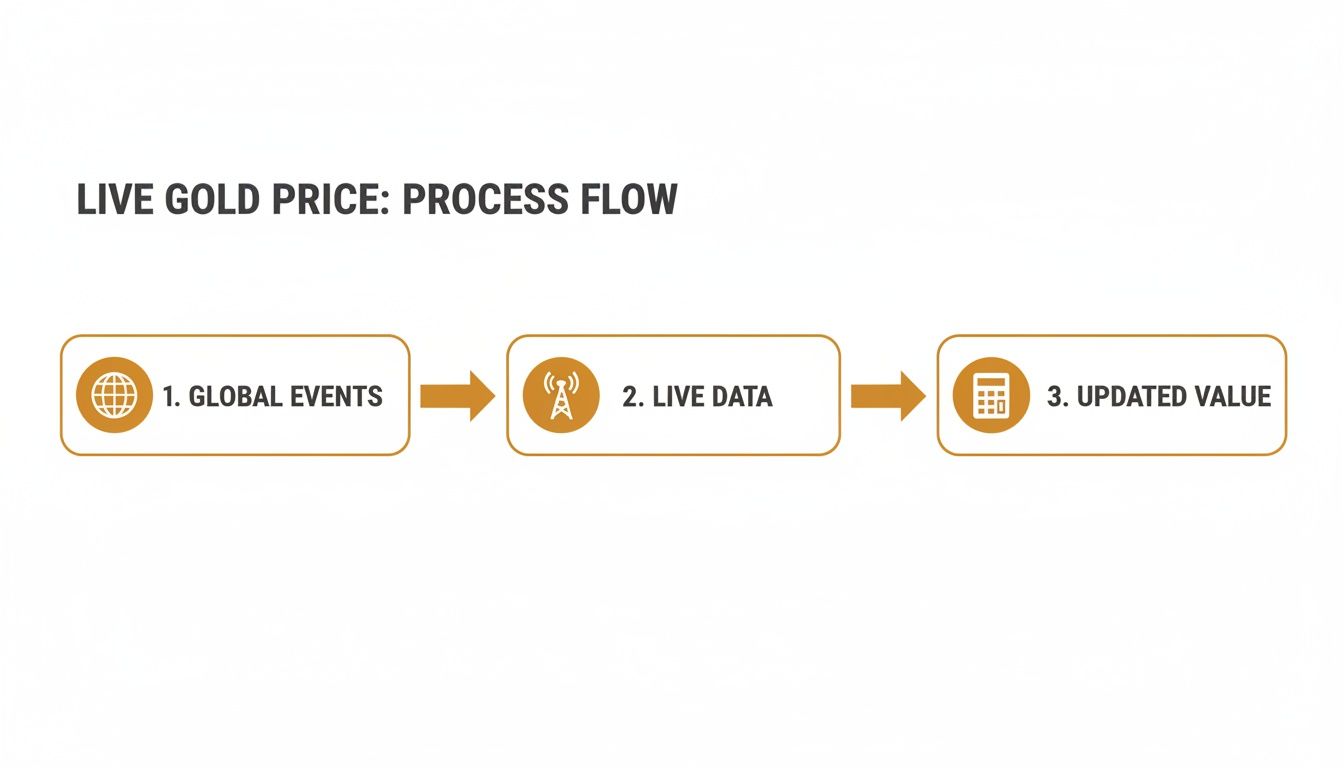
This is why a live calculator is so critical. Its value is always shifting to reflect what is happening in the real world, right now.
Step 1: Identify the Gold Purity
First things first: you need to know what you are working with. Most gold jewelry is not 100% pure. It is almost always an alloy, meaning it has been mixed with other metals to make it stronger and sometimes to change its color. The gold’s purity is marked with a tiny stamp called a hallmark, which you can usually find on the clasp, the inside of a ring, or on the back of a pendant.
You will want to look for small markings like these:
- 10K: This means the item is 10 parts gold and 14 parts other metals, making it 41.7% pure.
- 14K: A very common choice for jewelry in the U.S., this alloy is 58.3% pure gold.
- 18K: High end pieces are often made from 18K gold, which is 75% pure.
- 24K: This is pure gold, usually found in bullion bars or investment grade coins.
This little number is the single most important piece of information you will need for the calculator.
Step 2: Weigh Your Gold Accurately
Once you know the purity, the next step is to find out how much it weighs. For the best results, you need a digital scale that can measure in small increments like grams or pennyweights. A standard kitchen scale often is not sensitive enough to pick up the weight of smaller jewelry items accurately.
A crucial point here: make sure you are only weighing the gold. If a piece of jewelry has gemstones, diamonds, or any other non gold parts, their weight needs to be excluded from your total. An accurate weight is the foundation for a reliable valuation. For a deeper look at all the options, you can learn more about how our gold price calculator today works on TheGoldCalculator.com.
Remember to select the correct unit of measurement in the calculator. Grams are standard for jewelry, but investment grade gold is often weighed in troy ounces. Using the wrong unit will give you a wildly incorrect value.
Step 3: Input the Details and Get Your Value
With your gold’s purity and weight ready to go, you are all set. Head to the live gold calculator and simply select the karat from the dropdown menu, enter the weight you measured, and double check that you have chosen the correct unit. The tool will instantly calculate the estimated melt value based on the live spot price of gold.
To make this even clearer, this table breaks down the relationship between the karat stamp you see on your jewelry and the actual percentage of pure gold it contains.
Gold Purity Breakdown: Karat vs. Fineness
| Karat Value (K) | Fineness (Purity) | Pure Gold Content (%) |
|---|---|---|
| 10K | 417 | 41.7% |
| 14K | 583 | 58.3% |
| 18K | 750 | 75.0% |
| 22K | 916 | 91.6% |
| 24K | 999 | 99.9% |
This table helps you visualize exactly what the calculator is doing behind the scenes. It takes the total weight of your item and multiplies it by the pure gold content percentage to figure out what the raw precious metal inside it is truly worth.
Understanding What a Gold Buyer Will Actually Pay You
So, you have used a live gold calculator and have a number in front of you. That figure is the melt value, the raw, intrinsic worth of the pure gold in your item based on today’s market price. It is a fantastic starting point, but it is critical to know that this is not the final check you will receive.
When you sell your gold to a jeweler, refiner, or pawn shop, they will offer you a percentage of that melt value. This is standard practice across the industry. You can generally expect an offer somewhere between 70% and 95% of the full melt value.
That might sound like a huge spread, but there are solid business reasons behind it. Buyers have real world costs to cover, and those factors are baked right into their offer.
Why You Don’t Get the Full Melt Value
Think of it this way: a gold buyer is providing a service. They are taking your unwanted jewelry, which is not in a form the market can use, and investing their time, money, and expertise to convert it back into pure, tradable gold. Their offer simply reflects the costs of doing business.
Here’s a breakdown of why there is a difference between the melt value and your payout:
- Refining Costs: Your items do not magically become gold bars. The buyer has to send them to a specialized refinery where the gold is melted down and painstakingly separated from other metals. This industrial process involves chemicals, extreme heat, and skilled labor, all of which cost money.
- Overhead Expenses: Every business has bills to pay. This includes rent for their shop, employee salaries, insurance, high level security, and marketing. A small slice of every transaction goes toward keeping the lights on.
- Market Risk: Gold prices are always on the move. A buyer takes on a risk the moment they purchase your gold because the spot price could drop before they have a chance to sell the refined metal.
- Profit Margin: At the end of the day, a gold buyer is a business that needs to make a profit to stay open and continue serving customers. This margin is a necessary part of their pricing.
Understanding these factors helps set realistic expectations. An offer of 90% of the melt value is likely a very fair deal. If you get an offer below 70%, it might be a good sign to shop around.
Comparing Offers from Different Buyers
Not all buyers have the same business model, which is why their payout percentages vary. A local pawn shop with a physical storefront has different overhead costs than a large online mail in service. The table below gives you a general idea of what to expect from different types of buyers, helping you compare your offers. For a deeper dive, check out our guide to understanding the scrap gold price on TheGoldCalculator.com.
| Buyer Type | Typical Payout Range (% of Melt Value) | Key Considerations |
|---|---|---|
| Pawn Shops | 60% to 75% | Offer instant cash but their higher overhead often leads to lower payouts. |
| Local Jewelers | 70% to 85% | Good for building a trusted relationship; offers are usually fair but can vary. |
| Mail In Refiners | 80% to 95% | Often provide the highest rates due to lower overhead, but the process takes longer. |
Who Benefits from Using a Live Gold Calculator?
A live gold calculator is so much more than a simple online gizmo. It’s a powerful tool that brings instant, data driven clarity to anyone dealing with gold. Whether you are just cleaning out an old jewelry box or actively managing a precious metals portfolio, this tool gives you the foundation you need to make smarter financial moves.
For anyone holding onto old or unwanted jewelry, the calculator is the perfect first step before even thinking about selling. It gives you a transparent melt value, offering a solid baseline to measure any offers you get from buyers. This knowledge lets you walk into a pawn shop or jeweler with confidence, knowing exactly what the raw gold in your items is worth on the open market.
Investors and Collectors
For investors and serious collectors, the constant ebb and flow of the gold market is a source of both opportunity and risk. A live gold calculator acts like a personal dashboard, letting you track the real time value of physical assets like coins, bars, or even scrap gold holdings. You can get a quick portfolio assessment without having to wade through complex financial charts or call a broker.
By providing instant valuations, the tool helps investors make timely decisions, whether that is buying more gold during a price dip or selling assets at a profitable peak. It transforms a static collection into a dynamic, measurable part of your financial portfolio.
The global demand for gold has seen some massive shifts lately, with central banks buying over 1,000 tonnes a year since 2022. This huge demand, which now makes up nearly 25% of the global total, directly impacts the spot prices used by the calculator. For you, this means the value of your holdings is being influenced by large scale economic trends, making a live valuation tool more essential than ever. You can dig deeper into these structural market shifts on the VanEck blog detailing gold’s new era.
Business and Professional Applications
The calculator’s utility does not stop with individuals. It’s also a game changer in the professional world, offering a standardized and efficient way to value gold.
| User Group | Primary Benefit | Example Application |
|---|---|---|
| Jewelers & Pawn Shops | Consistent Intake Pricing | Quickly providing fair, market based offers for scrap gold from customers. |
| Estate Executors | Fair Asset Appraisal | Accurately valuing gold items for equitable distribution among beneficiaries. |
| Small Business Owners | Inventory Management | Tracking the current value of gold inventory used for crafting or resale. |
Each of these pros benefits from the tool’s impartiality and accuracy. For an estate executor, it eliminates guesswork and potential family disputes by grounding the appraisal in verifiable market data. For a jeweler, it streamlines the buying process and builds trust with customers by showing them a transparent valuation based on live prices.
From the casual seller to the seasoned professional, the live gold calculator has become an indispensable resource.
Common Mistakes to Avoid When Valuing Gold
Knowing what not to do is just as important as knowing what to do. A few simple oversights can lead to a surprisingly low valuation, leaving you feeling shortchanged. By understanding these common pitfalls, you can walk into any negotiation with the confidence that you are getting a fair and accurate assessment.
One of the most frequent slip ups is weighing jewelry without accounting for gemstones. A buyer is only interested in the precious metal, so the weight of any diamonds, sapphires, or other stones will be subtracted from the total. Always weigh your gold items after removing any non metal components to get an accurate starting point.
Another classic error is using an imprecise scale. That kitchen food scale just is not cut out for this job; it simply is not sensitive enough for smaller jewelry items. You absolutely need a digital jeweler’s scale that measures to at least a tenth of a gram (0.1g) to get a correct valuation.
Relying on Outdated Information
Perhaps the most costly mistake of all is basing your expectations on an old price. Gold’s value is in constant motion. A price from last week, or even just this morning, is already history.
The gold market’s volatility in 2025 saw prices surge dramatically, meaning a 10 gram 18k ring could nearly double in melt value over just a few months. This highlights why real time data is non negotiable.
This is exactly where a live gold calculator becomes your best defense. It pulls the most current spot price, ensuring your estimate reflects the market right now. This is crucial when prices are moving quickly, as highlighted in recent analysis of the gold market’s record breaking year.
Finally, mistaking gold plated or gold filled items for solid gold is a common letdown. These pieces have only a microscopic layer of gold and hold virtually no melt value. If you are unsure what you have, our guide on gold purity testing methods on TheGoldCalculator.com can help you sort it out. Avoiding these simple errors ensures you approach any valuation with realistic expectations and accurate information.
Common Questions About Gold Calculators
Got questions? We have got answers. Here are a few of the most common things people ask when using a live gold calculator for the first time.
How Accurate Are These Calculators?
The accuracy comes down to one thing: the data source. Our calculator does not guess. It pulls the live spot price directly from global commodity markets like COMEX, which is the exact same data the big financial players use. This ensures the value you see is based on the real time, pure gold price at that very moment.
Can I Figure Out the Value of Gold Coins or Bars?
You bet. Investment grade gold, like the coins and bars you see from mints, is almost always 24 karat (or 99.9% pure). Just pop “24K” into the calculator, enter the weight, and you will get a precise melt value based on the live spot price. It is that simple.
Why Is the Calculator’s Price Different from What I See on the News?
Great question. Financial news channels often quote the price of gold futures contracts, which are basically agreements to buy or sell gold at a set price on a future date. A live gold calculator, on the other hand, uses the spot price, the price for gold delivered right now. They are always very close, but small differences are normal.
Ready to find out exactly what your gold is worth? Use the free tool from Gold Calculator for an instant, transparent valuation based on live market data. Calculate your gold’s value now at TheGoldCalculator.com.