Your Guide to Using a Selling Gold Calculator for the Best Price
Think of a selling gold calculator as your personal, instant appraisal tool. It is a free online resource that gives you a quick, reliable estimate of what your gold is actually worth. All you do is enter your item’s weight and purity its karat, and the calculator does the rest. It uses the live market price of gold to figure out the melt value, giving you a powerful piece of information before you ever speak to a buyer.
Why You Need a Gold Value Estimate Before Selling
Ever found an old gold necklace and wondered if it was worth anything? You are not alone. Before you walk into a pawnshop or mail your items off to some online buyer, getting a solid estimate is your single biggest advantage. A selling gold calculator is the perfect first step.
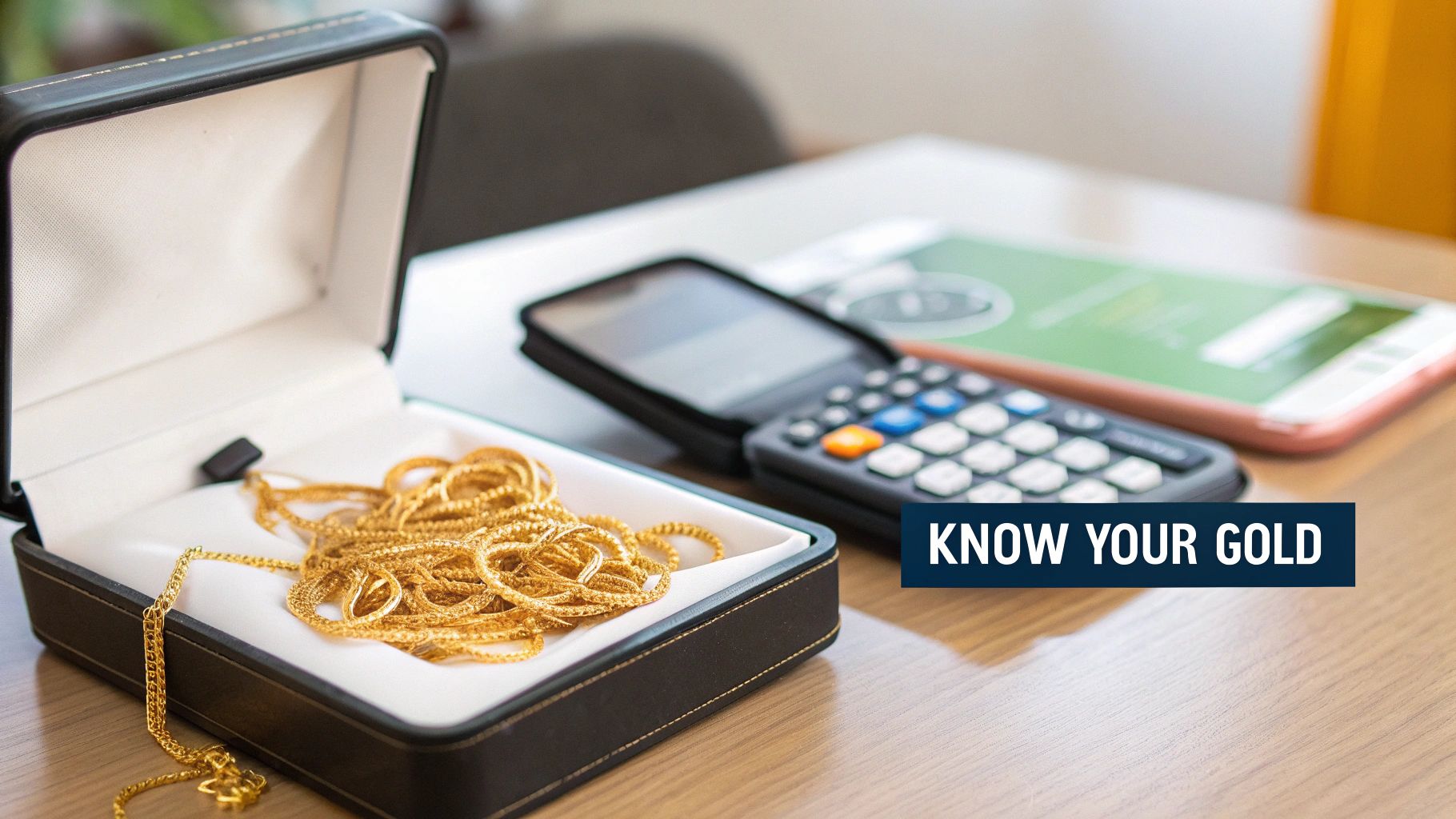
It empowers you with knowledge, turning what could be a confusing and intimidating process into a confident negotiation. The number it gives you the “melt value” is the baseline price for the raw gold in your jewelry. This number is the key to knowing if you’re getting a fair deal.
Setting Realistic Expectations
One of the best reasons to use a calculator is to ground your expectations in reality. Any buyer, whether it’s a local shop or a big online refiner, has business costs to cover. They have to pay for refining, insurance, shipping, and, of course, their own profit margin.
This means you will never be offered 100% of the melt value. Knowing the melt value first helps you understand why. A typical, fair offer will usually fall somewhere between 70% to 95% of the spot price you calculated.
A gold calculator doesn’t tell you what a buyer will pay; it tells you what your gold is worth on the global market. This distinction is crucial for negotiating the best possible price.
Building Confidence for Negotiations
Walking into a negotiation blind is a surefire way to get a bad deal. When you know the approximate value of your gold, you can confidently field offers and know a lowball when you see one.
A selling gold calculator provides a powerful starting point. It helps you instantly filter out lowball offers, effectively compare quotes from different buyers, and show that you’ve done your homework, which earns you more respect. This simple step transforms you from a passive seller hoping for the best into an informed one who can make a smart decision. The table below really highlights the difference it makes.
| Seller’s Position | Knowledge Level | Negotiation Power |
|---|---|---|
| Without Calculator Estimate | Low (Unaware of melt value) | Weak (Relies on buyer’s quote) |
| With Calculator Estimate | High (Knows the baseline value) | Strong (Can identify fair offers) |
Ultimately, using a calculator is about protecting yourself. It only takes a few minutes, but it provides the clarity you need to ensure you get a fair price for your precious metals and gives you peace of mind throughout the entire selling process.
How a Gold Value Calculator Actually Works
It might seem like a bit of digital magic, but a selling gold calculator really just boils down its process to three simple, core principles. Let’s pull back the curtain and demystify how it all works. Think of it like a recipe to get an accurate result, you need to measure three key ingredients perfectly.
Those three ingredients are purity, weight, and the live market price. Once you see how these elements interact, you’ll understand exactly how a calculator arrives at its valuation. That knowledge gives you the confidence to trust the numbers you’re seeing.
Gold Purity: The Karat System Explained
The first crucial piece of the puzzle is your gold’s purity, which we measure in karats (K). The karat number tells you how much pure gold is in your item compared to other metals, which are called alloys. Pure gold is 24K, but on its own, it’s far too soft for most jewelry. That’s why metals like copper, silver, or zinc are mixed in to give it strength and sometimes change its color.
The lower the karat, the less pure gold it contains. For example, a 14K gold ring isn’t pure gold; it’s 58.3% pure gold blended with 41.7% other metals. It’s this exact purity percentage that the calculator plugs into its formula.
The karat stamp on your jewelry is a direct indicator of its gold content. A calculator translates this stamp into a precise percentage to determine how much of your item’s weight is actual, valuable gold.
Here’s a simple table that shows how common karat types convert to gold purity the exact data a calculator uses in its math.
| Karat Value | Millesimal Fineness | Pure Gold Percentage |
|---|---|---|
| 24 Karat (24K) | 999 | 99.9% Pure Gold |
| 18 Karat (18K) | 750 | 75.0% Pure Gold |
| 14 Karat (14K) | 583 | 58.3% Pure Gold |
| 10 Karat (10K) | 417 | 41.7% Pure Gold |
The Importance of Accurate Weight
Next up is the weight. When you’re dealing with precious metals, every single gram matters. Any good calculator will let you enter the weight in different units, but grams (g) and troy ounces (ozt) are the industry standards.
A troy ounce, used specifically for precious metals, is actually about 10% heavier than a standard ounce, weighing in at 31.1 grams. This is why using an accurate digital scale is so critical; even a small error in weight can throw off the final value estimate significantly.
The Live Spot Price: The Engine of Valuation
The final and most dynamic component is the live spot price of gold. This is the real time market price for one troy ounce of pure, 24K gold on global commodity exchanges. It’s constantly in flux, changing by the minute based on everything from economic news to supply and demand shifts.
A reliable selling gold calculator taps directly into data feeds from trusted financial exchanges like COMEX to make sure its calculations are always up to the second. This live data is what makes the tool so powerful and useful.
The global gold market is enormous and never sleeps. In 2025, its value is projected to hit USD 308.32 billion and is expected to grow to over USD 457.90 billion by 2032. This just goes to show why sellers need precise tools. Most buyers will offer between 70% to 95% of the melt value, and with prices changing constantly, getting an instant, accurate estimate can easily mean hundreds more in your pocket.
A trustworthy tool like our live gold calculator instantly brings these three elements purity, weight, and live price together in a simple formula to give you a transparent melt value estimate.
Your Step by Step Guide to Calculating Gold Value
Ready to find out what your gold is really worth? Using a selling gold calculator is a surprisingly simple process that takes just a few minutes. This walkthrough will take you through each step, from digging out your items to getting a solid, real time estimate of their value.
Think of this as your personal valuation checklist. By following these quick steps, you’ll walk away with a confident, accurate picture of your gold’s worth based on today’s live market prices. Let’s jump in.
Step 1: Figure Out Your Gold’s Purity
First things first: you need to know your gold’s purity, also known as its karat. This is usually easier than it sounds. Most gold jewelry has a tiny stamp on it, called a hallmark, that tells you its purity level. You might need a magnifying glass to spot it, as these marks are often tucked away on a clasp, inside a ring, or on an earring post.
Keep an eye out for markings like 10K, 14K, or 18K: These are the most common karat markings you’ll see in North America. Or look for 417, 585, or 750: These three digit numbers represent the gold’s purity as a percentage. For instance, 585 means the item is 58.5% pure gold, which is just another way of saying it’s 14K.
If your items have different karat stamps, it’s crucial to sort them into piles. Tossing a 10K chain in with an 18K ring will throw off your entire calculation. Always weigh and calculate each purity level on its own.
Step 2: Get an Accurate Weight
Once your gold is sorted by karat, it’s time to weigh each pile. You don’t need a professional jeweler’s scale for a good estimate a digital kitchen or postage scale will do the trick. The most important thing is making sure it can measure in grams.
Before weighing, try to remove any non gold parts. If you have jewelry with gemstones, you’ll want to subtract their weight. As a quick rule of thumb, a 1 carat diamond weighs about 0.2 grams. For tiny stone chips, the impact is minimal, but for larger gems, the weight can make a real difference.
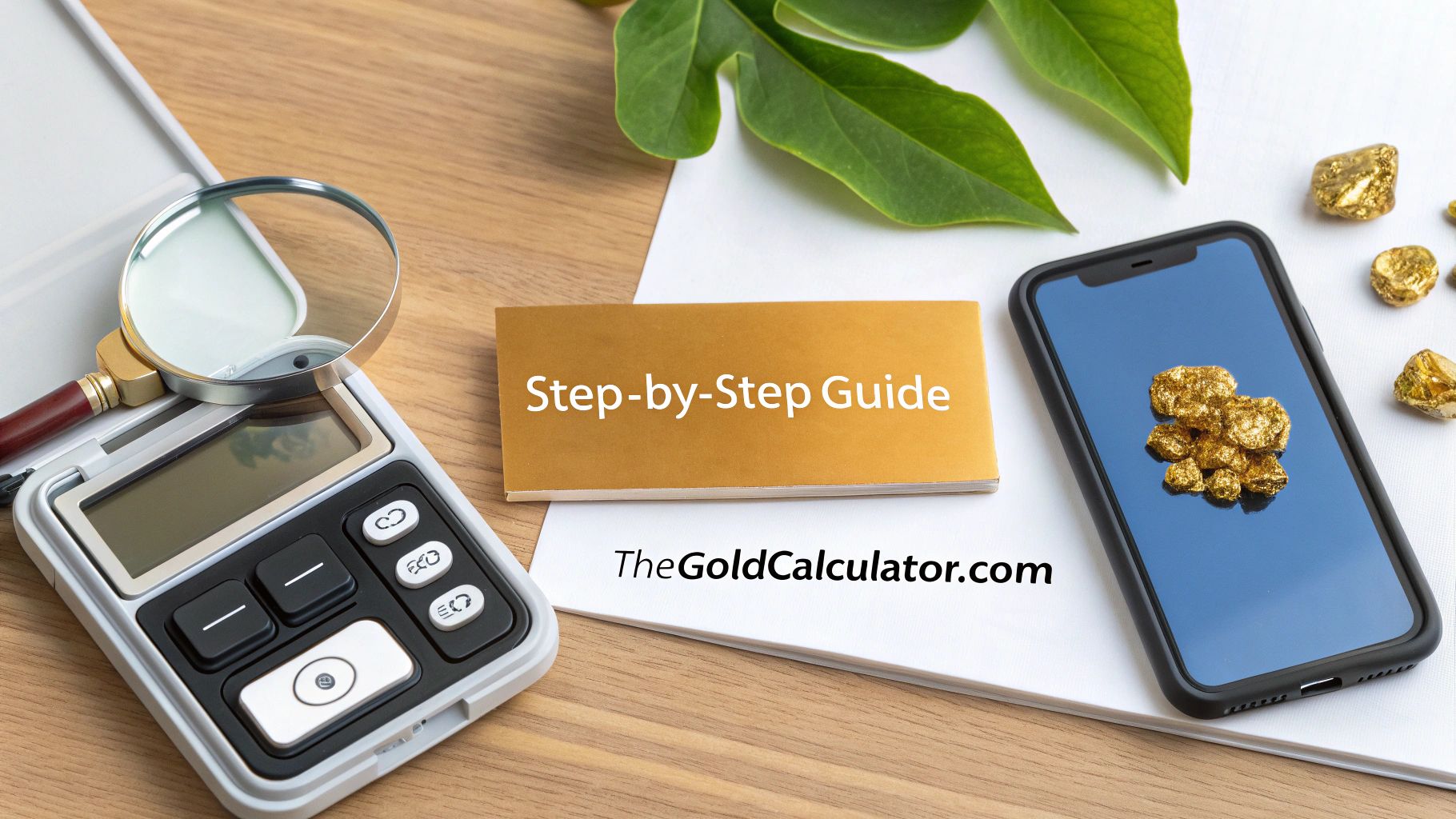
As you can see on a typical calculator like TheGoldCalculator.com, the interface is built for simplicity. The dropdowns for karat and weight units make entering your info a breeze.
Step 3: Plug Your Numbers into the Calculator
You’re at the final step! With your purity and weight in hand, you’re ready to get your estimate.
- Select the Karat: From the dropdown menu, choose the correct karat for the group of items you weighed.
- Choose the Weight Unit: Select “Grams” (or whatever unit you used).
- Enter the Weight: Type the total weight of that karat group into the field.
- See Your Result: The calculator instantly shows you the melt value, calculated using the live spot price of gold.
The number you see is the raw, intrinsic value of the actual gold in your items. This is your baseline, your starting point for any negotiation. It empowers you to walk into any sale knowing exactly what you’ve got.
Understanding the Difference Between Melt Value and Cash Offer
So, you’ve used a selling gold calculator and have an exciting number staring back at you: the melt value. This is the raw, intrinsic worth of the pure gold in your items, based on the live market price. But it’s critical to understand that this number is your starting point, not the final cash offer you’ll receive from a buyer.
Getting this distinction right is the most important step for setting realistic expectations. It’s what separates a confident, happy seller from a disappointed one.
The gap between the melt value and a cash offer boils down to what’s known in the industry as the “spread.” Think of it like any other business. A gold buyer has operational costs they need to cover to stay in business, and those expenses are bundled into the spread the percentage they keep from the total melt value.
A common misconception is that buyers are trying to lowball you when their offer doesn’t match the calculator’s value. In reality, their offer simply reflects the melt value minus their legitimate business costs and a margin for profit.
Understanding what those costs are makes it perfectly clear why the spread exists.
Why Is a Cash Offer Lower Than Melt Value?
A buyer’s offer is a direct reflection of their business model. They aren’t just buying gold; they’re running a complex operation that involves several expensive steps before they can ever turn a profit.
These operational costs almost always include refining and assaying fees, insurance and security, overhead costs, market fluctuation risk, and a profit margin. Buyers don’t just put your gold on a shelf. They have to send it to a professional refinery to be melted down, verified, and purified, and that service isn’t free. At the end of the day, gold buyers are a business. Just like a grocery store or a mechanic, they need to make a profit to stay open.
When you add all these factors up, a fair offer will typically range from 70% to 95% of the calculated melt value. This is standard practice across the entire industry, from the smallest local pawn shop to the largest online refiners. You can get a better sense of today’s prices by checking out our gold price calculator for today.
A Practical Example of Offers
Let’s make this tangible. Imagine your old jewelry has a calculated melt value of exactly $1,000. Based on the typical payout percentages, here is what you could realistically expect from different types of buyers.
How Buyer Offers Compare to a $1000 Melt Value
This table breaks down the potential cash offer you might receive from different buyers for a gold item with a calculated melt value of $1,000. It shows the typical payout percentage you can expect from each type of business.
| Buyer Type | Typical Payout Percentage | Potential Offer Range |
|---|---|---|
| Local Pawn Shop | 70% to 80% | $700 to $800 |
| Local Jeweler or Coin Dealer | 75% to 90% | $750 to $900 |
| Online Gold Buyer (Reputable) | 85% to 95% | $850 to $950 |
| Large Scale Refiner (Direct) | 90% to 98% | $900 to $980 |
As you can see, shopping around is a huge deal. A reputable online buyer with lower overhead might offer you $150 more than a local pawn shop for the exact same items. The recent volatility in the gold market makes this knowledge even more critical.
Just look at the first quarter of 2025. Gold started the year at $2,644.60 per ounce and skyrocketed to $3,120.20 by the end of March a massive 17.80% quarterly gain. This created a prime selling environment, with daily trading volumes averaging $137.67 billion. For sellers in major markets, knowing that offers would land in that 70% to 95% range after fees was the key to capitalizing on those record prices without getting a lowball deal. You can read more about these incredible market dynamics in the LBMA precious metals market report.
By understanding the spread and the real world factors that influence it, you can evaluate offers intelligently and confidently choose the one that puts the most cash back in your pocket.
How to Spot a Trustworthy Gold Calculator
Not all online calculators are created equal. Far from it. With dozens of tools out there, it’s all too easy to land on one that uses stale prices or shady math, leaving you with an estimate that’s wildly off the mark. A trustworthy selling gold calculator is your most important ally in this process, so knowing how to pick a good one is crucial.
Think of it like choosing the right tool for a delicate job. You wouldn’t use a rusty, department store wrench to fix a fine Swiss watch. In the same way, you need a precise, reliable instrument to measure the value of your precious metals. The right calculator builds confidence; the wrong one just creates confusion.
A great calculator is built on a foundation of transparency and accuracy. It should feel less like a sales gimmick and more like a public service designed to arm you with real data.
Real Time Data Is Non Negotiable
The single most important feature of any reliable gold calculator is its use of live market data. The price of gold changes constantly sometimes every few seconds based on global trading. A calculator pulling its prices from a static source or only updating once a day is practically useless.
A trustworthy tool will proudly display its data source and how often it updates. Look for mentions of reputable financial exchanges like COMEX or data providers such as Metals API. The best calculators refresh their prices every few minutes, making sure your estimate is as current as humanly possible.
The gold market is incredibly dynamic. With daily trading volumes reaching into the billions, even a few minutes can change the value of your items. A calculator that doesn’t use real time data is giving you an opinion, not a valuation.
This commitment to live data ensures the estimate you get reflects the true market value at the exact moment you’re checking. It’s the difference between a guess and a real world calculation.
Key Features of a Dependable Calculator
Beyond live data, several other features separate the best tools from the rest. A good selling gold calculator should be designed with your clarity and convenience in mind. It should be an open book, giving you all the information you need without asking for anything in return.
Here’s a quick rundown of what to look for versus what should make you immediately suspicious.
| Must Have Features | Red Flags to Avoid |
|---|---|
| Completely Free to Use | Requires a sign up or email |
| Supports Multiple Weight Units | Only supports one unit (e.g., grams) |
| Updates Prices Every Few Minutes | Vague or no info on price updates |
| Calculates for Various Currencies | Only calculates in a single currency |
With gold prices poised to shatter records, accuracy is everything. Some market projections show spot gold surging past $3,600 per ounce in late 2025, which would deliver massive gains for anyone holding gold. For sellers, this is a huge opportunity, but it also comes with risk, as buyers typically pay 70% to 95% of the melt value. This is where tools offering free, real time estimates truly shine, bridging the gap between record high prices and the actual cash you’ll receive. You can dive deeper into these gold market trends and insights at delmorganco.com.
Practical Tips to Get the Best Price for Your Gold
Okay, you’ve used a selling gold calculator and now have a solid estimate of your gold’s melt value. This number is your new best friend it transforms you from a regular seller into an informed negotiator. Now, let’s turn that knowledge into more cash in your pocket.
These aren’t complicated industry secrets, just simple, practical strategies to help you get the absolute best payout and walk into any negotiation with confidence.
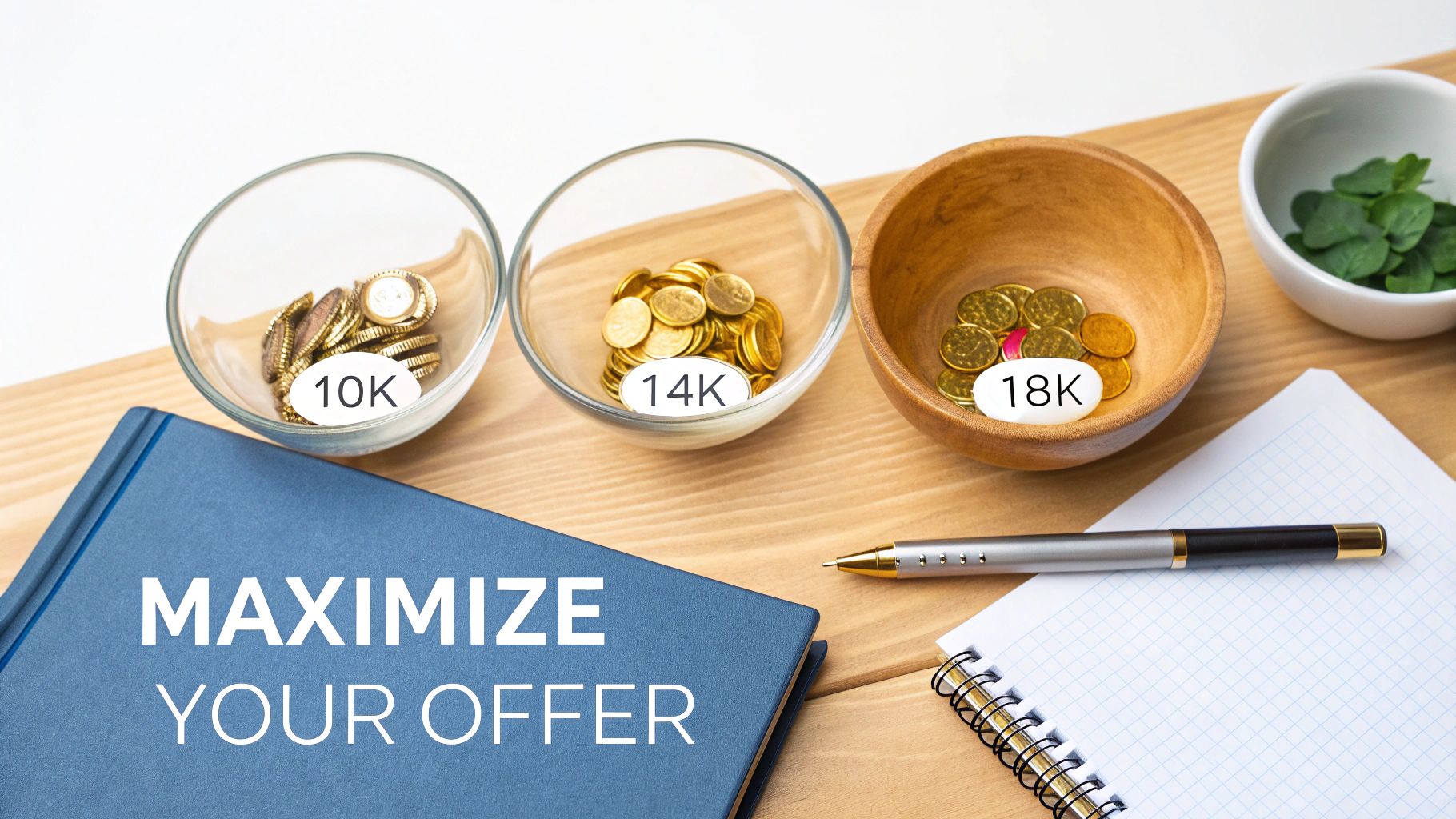
Think of the melt value from the calculator as your strategic baseline. The following tips are your playbook for ensuring the final offer you accept is as close to that baseline as possible.
Always Separate Your Gold by Karat
This is the single most important and most overlooked step in the entire process. Never, ever mix your gold items of different purities. If you hand a buyer a single bag with a jumble of 10K, 14K, and 18K gold, they will almost always price the entire lot based on the lowest karat, which would be 10K in this case.
It’s a common mistake that can literally cost you hundreds of dollars. Before you even think about weighing anything, sort your items into separate piles based on their karat markings. This simple action guarantees each piece gets valued correctly for its actual gold content.
Weigh Your Gold at Home First
Knowledge is power in any negotiation. Before you even step out the door, weigh each of your karat sorted piles on a digital kitchen or postage scale. It doesn’t have to be a professional jeweler’s scale just having your own measurements gives you a critical reference point.
This quick step prevents any nasty surprises and lets you double check the buyer’s measurements on the spot. If their weight comes in significantly lower than yours, you have every right to ask why or simply walk away and get a second opinion.
Shop Around for Multiple Quotes
You wouldn’t buy the first car you see, so why accept the first offer you get for your gold? Every buyer operates with different overhead costs and profit margins, which means their offers can vary wildly. Getting at least two to three different quotes isn’t just a good idea; it’s essential.
A buyer’s offer is a reflection of their business model, not just the value of your gold. Securing multiple quotes is the only way to find the buyer whose model pays you the most.
Comparing offers is the only way to see the true range of potential payouts in your area. You can find more info on finding trustworthy buyers in our complete guide to the best places to sell gold.
Consider Value Beyond the Melt Price
While a calculator is perfect for figuring out the raw material value, some items are worth far more than their weight in gold. Before you agree to sell something for scrap, take a moment and ask if it might have additional value. Examples include antique or designer jewelry from brands like Tiffany & Co., valuable gemstones like diamonds, or numismatic coins that a dealer would pay a premium for.
Here’s a simple way to think about what you have:
| Item Type | Primary Value Driver | Best Selling Approach |
|---|---|---|
| Broken Chains, Single Earrings | Gold Melt Value | Sell to a gold buyer or refiner. |
| Designer Necklace, Antique Ring | Brand or Historical Value | Sell to a jeweler or collector. |
| Gold Coin (e.g., Eagle) | Gold Content & Coin Premium | Sell to a reputable coin dealer. |
Taking a few minutes to assess your items for these traits can sometimes lead to a much, much higher payout than the melt value alone.
A Few More Questions Before You Sell
Even with a solid estimate from a gold calculator, you probably have a few last minute questions. That’s completely normal. Selling gold is a big decision, and you want to be sure you’ve covered all your bases.
Let’s clear up some of the most common things people ask right before they sell. Think of this as the final check in to make sure you walk in confident and ready to get a great deal.
Does It Matter if My Gold Jewelry Is Broken?
Not one bit. When you’re selling gold for its melt value, the buyer only cares about the raw material.
A tangled, broken chain, a single earring without its match, or a bent ring all have the same value as a pristine piece, as long as the weight and purity are identical. A broken 14K gold chain is worth exactly the same as one in perfect condition because it’s all getting melted down anyway.
Should I Remove Gemstones Before Selling?
Yes, especially if they’re valuable. If you can pop them out without damaging the gold, it’s a good idea.
Buyers will subtract the estimated weight of any stones before making an offer, and their guess might not be in your favor. If you have valuable stones like diamonds, rubies, or sapphires, it’s smart to have a professional jeweler remove and appraise them separately. You can often sell those for a better price on their own.
For tiny, low value stones (like small accent chips), the buyer will just factor them out of the weight. Removing them beforehand simply guarantees you’re getting paid for every last bit of gold.
A 1 carat diamond weighs 0.2 grams. That might not sound like much, but in the world of gold, it can definitely skew the weight and lower your payout. Removing it ensures the scale is only measuring your gold.
Here’s a quick guide on how to handle different stones:
| Stone Type | Recommended Action |
|---|---|
| Small, Low Value Stones | The buyer will subtract the weight; removing them isn’t critical. |
| Large or Valuable Gems | Have a professional jeweler remove and appraise them separately. |
What Is the Difference Between Ounces?
This is a huge one, and getting it wrong can cost you. The “ounce” you use for cooking is called an avoirdupois ounce, and it weighs about 28.35 grams.
But precious metals are always weighed in troy ounces, which are heavier at 31.1 grams.
The live gold price you see on the news or online is quoted per troy ounce. It’s absolutely critical to confirm that both you and the buyer are talking in troy ounces to ensure you’re getting a fair price based on the proper industry standard.
Ready to put all this knowledge to work? The Gold Calculator gives you a free, instant estimate based on live market prices, so you know what your items are worth before you even talk to a buyer. Try our free selling gold calculator now.