How a Gold Calculator Per Gram Gives You Accurate, Real Time Pricing
Ultimately, the value of your gold comes down to two simple things: how pure it is, known as its karat, and what the live market price is at this very moment. A gold calculator per gram is hands down the easiest way to bring these two factors together, giving you a clear, instant melt value estimate in just a few clicks.
How to Instantly Calculate Your Gold’s Value
Think of a gold calculator as your personal expert, doing all the tedious work for you. It handles all the tricky conversions for different weights, pulls in real time pricing data, and adjusts for purity so you do not have to wrestle with the math yourself. This approach gives you the immediate, transparent estimate you need before you even consider selling.
To give you some perspective, the value of gold has been on a wild ride through history. For example, a single gram of gold that might have been worth a few dollars in the early 1970s soared to over $27 per gram by 1980. More recently, prices have climbed to incredible heights, turning a 100 gram bar that might have been worth around $3,370 a few decades ago into one valued at over $7,500 today.
Why Live Data Matters
Using a tool that pulls live data is non negotiable. The price of gold is constantly in motion, changing by the minute. Relying on an outdated price can lead to a valuation that is wildly off the mark, leaving you with a completely false idea of what your items are worth. A good calculator makes sure your estimate is grounded in today’s reality.
The image below shows you just how simple a real time gold calculator can be.

With a clean layout like this, you can just plug in the gold’s karat and its weight in grams to see its current market value instantly. There is no guesswork or confusion, which makes it the perfect starting point for anyone curious about what their gold is worth. You can see it in action by checking out our live gold calculator.
Understanding the Live Gold Spot Price
Every calculation starts with one fundamental number: the live gold spot price.
Think of it as the raw, wholesale cost of pure, 24 karat gold before it is ever shaped into a ring, coin, or bar. This is the baseline price for one troy ounce, a standard unit in the precious metals world that equals 31.1035 grams.
This price is not just pulled out of thin air. It is set by the constant buying and selling on major global commodity exchanges, like COMEX in New York, where gold is traded nearly 24/7. The price is always moving, reacting in real time to global economic news, the strength of currencies like the US dollar, and shifts in investor demand.
Why Real Time Data Is Everything
In the gold market, a few hours can make a huge difference. Using a price from yesterday, or even just this morning, could throw your entire valuation off. That is why a reliable gold calculator has to tap directly into live data feeds, ensuring the price it uses is current to the minute. This is not just a nice feature; it is essential for getting a trustworthy estimate.
For example, imagine holding a single gram of pure gold. Let’s say the spot price is $2,330 per troy ounce. That translates to roughly $74.91 per gram, a significant amount for a tiny piece of metal. This is not just a number on a screen; it is real money for people cashing in on old jewelry.
History shows just how much this matters. In 2011, the price per gram peaked near $64, only to dip to about $35 by 2016 before starting its climb again. You can dive deeper into these trends by exploring historical gold price fluctuations on Investing.com.
The spot price is the foundation for every gold transaction. Without knowing the live price, any valuation is just a guess. It is the starting point from which every other factor, like purity and weight, is applied.
This constant movement is exactly why professional buyers and pawn shops always have the live price on their screens when they make an offer. They know that a small percentage change can add up to a significant dollar amount, especially with heavier items.
How Spot Price Is Quoted
While the official spot price is quoted in US dollars per troy ounce, a good gold calculator needs to be versatile. It should instantly convert this into whatever units and currency you are actually using. This flexibility is what makes it a practical, everyday tool.
Here is a quick breakdown of how the spot price translates across common units of measurement:
| Measurement Unit | Grams Equivalent | Typical Use Case |
|---|---|---|
| Troy Ounce (ozt) | 31.1035 grams | The global standard for quoting all precious metals. |
| Gram (g) | 1 gram | The most common unit for weighing jewelry and scrap gold. |
| Pennyweight (dwt) | 1.555 grams | An older unit you might still see used by some jewelers in the US. |
| Tola | 11.66 grams | A traditional unit of mass common in South Asia and the Middle East. |
Why Gold Purity Is Crucial for Accurate Valuations
Not all gold is created equal. After you have weighed your item, figuring out its purity is the single most important step you can take. Using a gold calculator per gram is basically pointless without this key piece of information, because purity directly determines how much of your item’s weight is actual gold.
Think of pure, 24 karat gold like juice concentrate. It is 100% the real thing, but it is also incredibly soft and not very practical for things you use every day. To make it strong enough for jewelry that can survive daily wear, it has to be mixed with other metals, called alloys, just like you would mix that concentrate with water.
This mixing process creates the different karat levels you see stamped on jewelry. An 18 karat ring, for instance, is not 100% gold. It is made of 18 parts gold and 6 parts other metals, which makes it exactly 75% pure gold.
Decoding Karats and Fineness Markings
When you look closely at a piece of gold jewelry, you will usually find a tiny stamp called a hallmark or purity stamp. This little marking tells you everything you need to know about its purity. These stamps show up in two common formats: the karat system (popular in the US) or the millesimal fineness system (common in Europe and on bullion).
Here is a quick guide to what those numbers actually mean:
| Karat (K) | Gold Purity Percentage | Fineness Marking | What It Means |
|---|---|---|---|
| 24K | 99.9% | 999 | This is pure gold, almost always found in investment grade bars and coins. |
| 18K | 75.0% | 750 | A high quality blend common in fine jewelry, with a rich, deep golden hue. |
| 14K | 58.3% | 585 or 583 | The most popular choice for jewelry in the US, hitting the sweet spot between durability and value. |
| 10K | 41.7% | 417 | The minimum legal standard for gold in the US, offering durability at a lower price point. |
Finding these markings is essential. They are often hiding in plain sight on the inside of a ring’s band, the clasp of a necklace, or the post of an earring. You might need a magnifying glass to see them clearly, but finding one removes all the guesswork from your valuation.
Without knowing the correct karat, you are simply guessing at your gold's value. An accurate calculation depends entirely on using the right purity percentage to determine the true amount of gold in your item.
This is exactly why a gold calculator per gram requires you to input the karat. The tool automatically does the math, applying the correct purity percentage to the current gold price. For instance, it knows that the value of one gram of 14K gold is precisely 58.3% of the value of one gram of pure 24K gold.
If you are having trouble identifying these markings or suspect your item is unmarked, do not worry. You can learn more about professional methods in our guide on how to test gold purity.
A Step By Step Guide to Calculating Gold Value
Now that you have a handle on spot price and purity, let's roll up our sleeves and walk through how the math actually works. Seeing it all laid out not only pulls back the curtain on how gold is valued but also shows you just how much time a good gold calculator per gram can save.
We will start with the old school way: doing the calculation by hand. While the formula might look a bit complex at first glance, it is really just a few simple steps.
The Manual Calculation Formula
To find the raw melt value of your gold, here is the core formula you need to know:
(Spot Price / 31.1035) × (Karat / 24) × Weight in Grams
Let's break that down. First, it converts the spot price from its standard troy ounce measurement into a price per gram. Then, it adjusts that price for your item's specific purity (karat). Finally, it multiplies that adjusted price by how much your item weighs.
Let’s use a really common example: a 14K gold necklace that weighs 15 grams. For this calculation, we will pretend the live spot price of gold is $2,330 per troy ounce.
-
Find the Price Per Gram: The first thing you have to do is divide the spot price by 31.1035, that is how many grams are in a single troy ounce.
- $2,330 / 31.1035 = $74.91 per gram for pure, 24K gold.
-
Adjust for Purity: A 14K piece is not pure gold, so we need to account for that. You find the purity percentage by dividing the karat by 24 (so, 14 / 24 = 0.583, or 58.3%). Now, multiply the pure gold price by that percentage.
- $74.91 × 0.583 = $43.67 per gram for 14K gold.
-
Calculate the Total Value: The last step is easy. Just multiply the 14K price per gram by the weight of your necklace.
- $43.67 × 15 grams = $655.05
And there you have it. The total melt value of that 14K necklace is $655.05.
The Simpler Way Using a Gold Calculator
Doing the math yourself is a great way to understand the process, but it is slow and leaves plenty of room for error. You have to hunt down the live spot price, remember the conversion factor for troy ounces, and know all the different purity percentages.
This is where a dedicated tool shines. Using a trusted online resource like TheGoldCalculator.com, the entire process becomes effortless. You would simply:
- Select 14K from the purity dropdown.
- Enter 15 in the weight field.
- Choose Grams as the unit.
That is it. The calculator grabs the live spot price, does all the conversions, and spits out the final value in an instant. It removes any chance of a math error and guarantees you are working with the most up to the minute market data. This is crucial because the price of gold per gram is not static; it is a live pulse that changes constantly.
For instance, you can see how gold prices react to global events on TradingEconomics.com to get a feel for just how dynamic the market can be.
The infographic below helps visualize why that purity adjustment we made is so important. It shows exactly how the amount of pure gold changes as you go from 24K down to 14K.
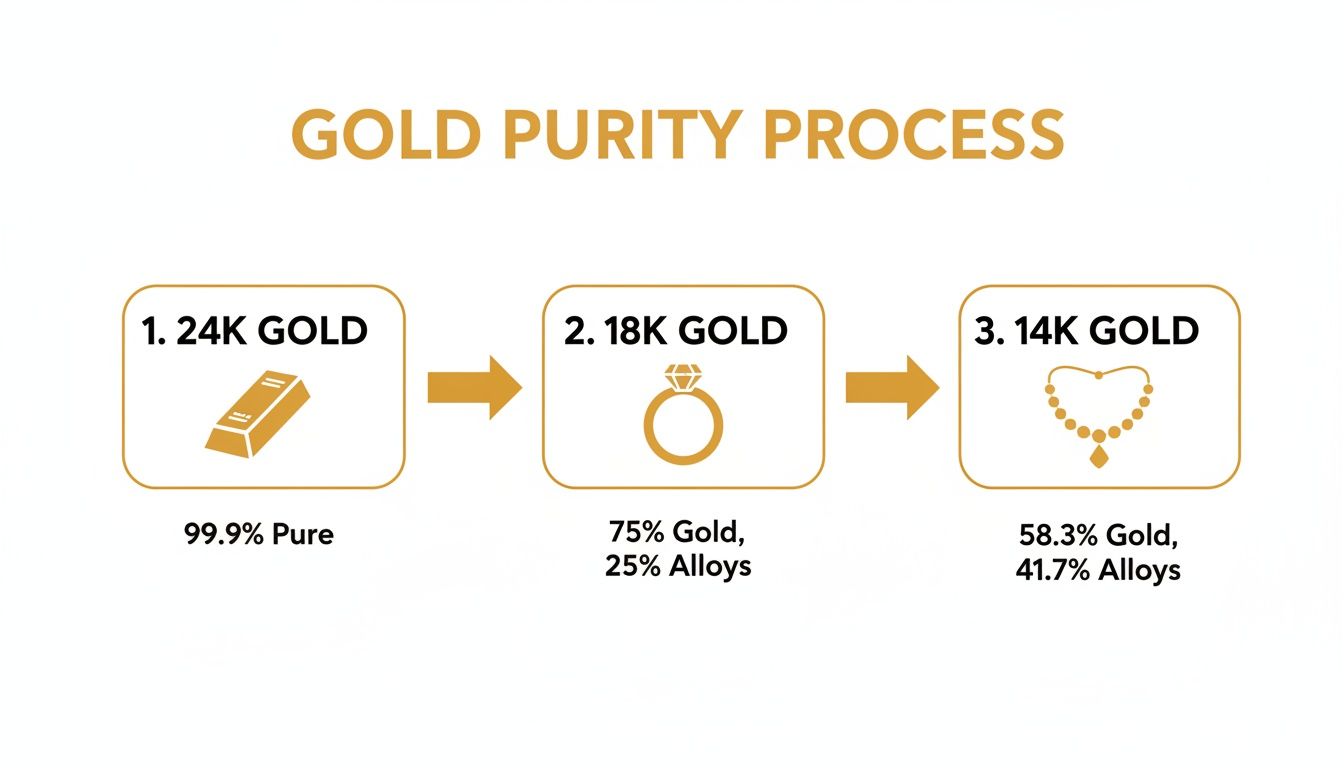
This visual makes it crystal clear that a 14K item has a lot less actual gold in it than a 24K piece of the exact same weight. That difference directly impacts its final melt value, which is why that second step in our manual calculation is absolutely mandatory for an accurate valuation.
Interpreting Your Results and What Buyers Actually Pay
You have punched the numbers into a gold calculator and now you have a figure. That number is the melt value, the raw, intrinsic worth of the gold in your item based on the live market price. But here comes the reality check every seller needs to hear: the melt value is not the same as the cash offer you will get from a buyer.

Think about it from their perspective. Pawn shops, jewelers, and online gold buyers are all businesses. They have rent, employee salaries, insurance, and the complex, costly process of refining your scrap gold back into its pure, usable form. On top of all that, they have to turn a profit to keep the lights on.
Because of these very real costs, a buyer will always offer a percentage of the full spot melt value, not the entire amount. This is not a scam; it is a standard and necessary industry practice.
Understanding Refining Fees and Buyer Margins
When a buyer takes your gold, it does not just sit on a shelf. It gets sent to a specialized refinery where it is melted down, the other metals (alloys) are chemically separated, and the pure gold is extracted. This industrial process, known as refining, has significant costs, which are ultimately factored into the offer you receive.
A simple way to think about it is this: The melt value is like the sticker price on a new car. The buyer's offer is the price after they have accounted for their business costs and a reasonable profit margin. Your goal is to find a buyer who operates with a fair, transparent margin.
So, what should you realistically expect to be offered? Payouts can vary quite a bit, but they generally fall within a predictable range. The table below gives you a rough idea of what different types of buyers might pay as a percentage of your gold's total melt value.
| Buyer Type | Typical Payout Percentage | Best For |
|---|---|---|
| Local Pawn Shops | 60% to 80% | Quick cash, but often the lowest payout. |
| Jewelry Stores | 70% to 85% | Better rates, especially if you have an existing relationship. |
| Reputable Online Buyers | 80% to 95% | Often the highest payouts due to lower overhead. |
This is where a good gold calculator per gram becomes so powerful. The best tools do not just stop at melt value; they let you factor in an estimated refining fee or buyer's percentage right into the calculation. By toggling this setting, you can instantly shift from a theoretical value to a much more realistic estimate of the cash you will actually walk away with. For instance, our gold price calculator today includes options to see these adjusted figures.
Having this knowledge completely changes the dynamic. When you walk into a shop knowing that an offer of 85% of melt value is fair, you can confidently turn down a lowball offer of 65%. It transforms the negotiation from a guessing game into a conversation based on solid, real world data.
Common Mistakes to Avoid When Valuing Your Gold
Knowledge is your best defense against getting a bad deal. When you are trying to figure out what your gold is worth, even small, innocent mistakes can lead to a surprisingly inaccurate valuation. Let's walk through some of the most common pitfalls that can cost you money and, more importantly, how to sidestep them.
Getting these details right is about more than just numbers; it is about making sure your calculation truly reflects your gold's worth. This builds the confidence you need when it is time to sell.
Confusing Different Units of Weight
One of the easiest and most costly mistakes is mixing up units of measurement. It happens all the time. Gold is traded on the global market in troy ounces, but your local jeweler or pawn shop will almost certainly weigh your items in grams or maybe even pennyweights (dwt). Using the wrong one can throw your entire calculation off by a huge margin.
A standard ounce (like the one on your kitchen scale) is 28.35 grams. But a troy ounce, the standard for precious metals, is 31.1035 grams. A pennyweight is 1.555 grams. You can see how grabbing the wrong number would give you a completely incorrect value.
Always, always confirm the unit your scale is set to and make sure it matches what you are using for your calculation. Most digital scales let you toggle between grams (g), ounces (oz), and other units, so take a second to double check the setting on the screen.
Forgetting to Account for Gemstones
That beautiful diamond or ruby definitely adds to your jewelry's aesthetic appeal, but it is not gold. Forgetting to subtract the weight of gemstones is another frequent error that artificially inflates the perceived gold content and, therefore, its estimated value.
A buyer will always weigh the gold after the stones have been removed, or they will estimate the stone's weight and subtract it. As a general rule of thumb, a 1 carat diamond weighs 0.2 grams. While a few tiny stones will not drastically alter the total weight, larger ones can make a significant difference.
Here is a quick comparison to see just how much non gold elements can impact your final valuation.
| Item Description | Total Weight | Non Gold Weight | Actual Gold Weight |
|---|---|---|---|
| Plain 14K Gold Band | 5 grams | 0 grams | 5 grams |
| 14K Gold Ring with 2ct Diamond | 5 grams | 0.4 grams (2 x 0.2g) | 4.6 grams |
| Gold Plated Necklace | 10 grams | ~9.9 grams | ~0.1 grams |
This table makes it crystal clear why isolating the weight of the gold itself is so critical. At the end of the day, you are selling the metal, not the attachments. When in doubt, assume any calculator is asking for the weight of the gold content alone.
Common Questions About Valuing Your Gold
We have covered a lot of ground, but you might still have a few lingering questions. Let's tackle some of the most common ones that come up when people are trying to figure out their gold's value.
How Often Does the Price of Gold Per Gram Change?
The short answer? Constantly. During market hours, the price of gold is always in motion, sometimes shifting minute by minute based on global trading activity.
This is exactly why using a calculator that pulls live data is so critical. It guarantees your valuation is based on the current spot price, not a stale number from a few hours or even a few minutes ago.
Does a Gold Calculator Work for Gold Coins and Bars?
Absolutely. In fact, a gold calculator per gram is perfect for valuing investment grade coins and bars. These items are almost always clearly marked with their weight and purity, which is typically .999 fine (the equivalent of 24k).
Just keep in mind that some collectible coins carry a "numismatic value" that goes far beyond their simple gold content. A melt value calculator will not capture that collector's premium.
Why Is My Offer Lower Than the Calculator's Estimate?
This is the most common point of confusion, but it makes perfect sense when you think about it. Your calculator shows you the 100% theoretical melt value based on the live spot price.
However, gold buyers are running a business. They have real world costs to cover, like refining, insurance, and overhead, and they need to turn a profit to stay open. For this reason, you can expect a typical offer to be somewhere between 70% to 95% of the full melt value. A good calculator will even have an option to estimate this payout, giving you a much more realistic idea of the cash you can expect to walk away with.
Ready to find out what your gold is really worth with total precision and confidence?
Use the free, real time Gold Calculator to get an instant, accurate estimate based on live market data. Visit us at https://thegoldcalculator.com to calculate your gold's value in just a few clicks.